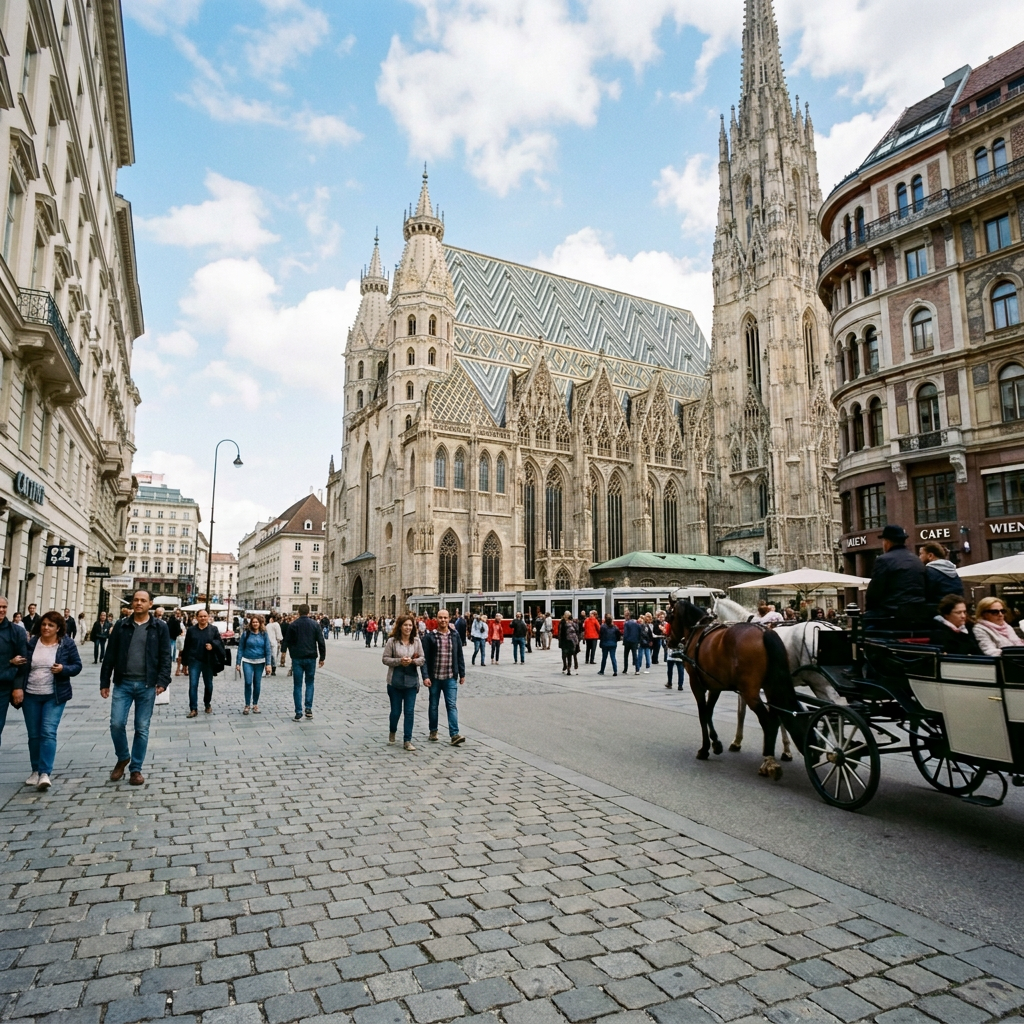
Vienna is one of the great imperial cities of Europe – a city of extraordinary museums, palaces, concert halls, and coffee houses, where the Austro-Hungarian Empire’s ambition expressed itself in architecture and culture on a scale that still impresses two centuries later. It is also a deeply liveable, walkable city with one of the world’s finest public transport systems, a café culture unlike anywhere else, and a quality of life that regularly places it at the top of global rankings.
📢 Affiliate Disclosure: This post contains affiliate links to Viator. If you book through our links, The Wandering Adventurer earns a small commission at no extra cost to you. Thank you for supporting independent travel content!
This guide covers the top things to do in Vienna – with Viator booking links, entry costs, U-Bahn stops, and insider tips for every attraction.
🗺️ Quick Book: Top Vienna Experiences
| Experience | From | Book |
|---|---|---|
| 🏰 Schönbrunn Palace Skip-the-Line + Garden Tour | $65 | Viator |
| 🏛️ Best of Vienna: Historic Center Walking Tour | $25 | Viator |
| 🎵 Mozart Concert in Historical Costumes at the Musikverein | $59 | Viator |
| 🌼 Upper Belvedere Entry Ticket — Klimt’s Kiss | $22 | Viator |
| 👑 Skip-the-Line Sisi Museum, Hofburg & Gardens Tour | $35 | Viator |
💡 Schönbrunn and the Musikverein concert sell out days ahead in peak season — book as soon as your dates are confirmed.
🏰 1. Schönbrunn Palace & Gardens
🕐 Time needed: 2.5–4 hours | 💶 Cost: Grand Tour €26; Classic Tour €20; gardens free | 🚇 U-Bahn: Schönbrunn (U4 – Green) | 📍 Address: Schönbrunner Schloßstraße 47, Vienna 1130
Schönbrunn Palace — the summer residence of the Habsburg emperors — is one of the most magnificent Baroque palace complexes in Europe: 1,441 rooms, 40 open to the public, each more extravagantly decorated than the last with gilded ceilings, Chinese lacquered panels, and Rococo stucco work. The formal gardens rise to the Gloriette pavilion, from which the panorama of Vienna is one of the finest in the city.
💡 Insider Tip: Book skip-the-line tickets in advance — Schönbrunn is Austria’s most visited attraction and entry queues can be substantial. The combined Schönbrunn & Garden Tour includes a guided skip-the-line palace visit.
🎟 Book the Schönbrunn Palace & Garden Tour via Viator
🎨 2. The Kunsthistorisches Museum
🕐 Time needed: 2.5–4 hours | 💶 Cost: €21 (book online) | 🚇 U-Bahn: Volkstheater (U2/U3) or Museumsquartier (U2) | 📍 Address: Maria-Theresien-Platz, Vienna 1010
The Kunsthistorisches Museum — the Art History Museum — is one of the great art museums of the world, housed in a purpose-built imperial palace facing the Natural History Museum. The collection reflects 500 years of Habsburg collecting: one of the world’s finest Bruegel collections, an extraordinary Venetian collection (Titian, Veronese, Tintoretto), major works by Raphael, Rembrandt, Caravaggio, Dürer, and Rubens, and the incomparable Kunstkammer — the imperial cabinet of curiosities.
💡 Insider Tip: Don’t miss the Bruegel room (Room X on the first floor) — it contains one of the most remarkable concentrated holdings of any single painter anywhere in the world. The museum café in the central dome is one of the most beautiful places to have coffee in Vienna.
🎟 Book the Kunsthistorisches Museum Entrance Ticket via Viator
🎵 3. A Vienna Concert or Opera Experience
🕐 Time needed: 1.5–3.5 hours | 💶 Cost: Standing tickets at the State Opera from €4–10; Musikverein concert from $59 | 🚇 U-Bahn: Karlsplatz (U1/U2/U4) | 📍 Musikverein address: Musikvereinsplatz 1, Vienna 1010
Vienna is the world’s music capital — the city of Mozart, Beethoven, Schubert, Strauss, and Mahler, where more great music was composed, performed, and premiered than anywhere else in history. Attending a performance at the Vienna State Opera or a concert at the Musikverein (home of the Vienna Philharmonic) is one of the great cultural experiences on earth.
💡 Insider Tip: Standing tickets at the Vienna State Opera are among the great travel bargains — €4–10 for one of the world’s finest opera companies. For a guaranteed seat, the Mozart Concert in Historical Costumes at the Musikverein (1,028 reviews) is Vienna’s most-booked classical concert, with 30 musicians and opera soloists performing in period dress.
🎟 Book the Mozart Concert at the Musikverein via Viator
☕ 4. Vienna’s Coffee House Culture
🕐 Time needed: 1–2 hours per café; food tour 3 hours | 💶 Cost: Coffee €4–8; guided food tour from $85 | 🚇 U-Bahn: Various — see individual café locations | 📍 Classic cafés: Café Central (Herrengasse 14), Café Landtmann (Dr.-Karl-Lueger-Ring 4), Demel (Kohlmarkt 14)
The Viennese coffee house is a UNESCO-recognised cultural phenomenon. These are not cafés in the conventional sense but institutions: grand, marble-floored, newspaper-furnished rooms where you can nurse a single Melange for three hours without anyone asking you to move on, eating a slice of Apfelstrudel or Sachertorte, and watching Viennese life unfold around you. Freud worked here. Trotsky played chess here. Stefan Zweig wrote here.
💡 Insider Tip: Café Central (in a stunning vaulted former palace) and Café Landtmann (Freud’s regular) are the grandest and most atmospheric. Vienna for Food Lovers: Hidden Cafés & Market Gems (1,193 reviews) combines a traditional coffee house stop with the Naschmarkt and local street food — a great way to structure your first morning in the city.
🎟 Book the Vienna Coffee House & Market Food Tour via Viator
👑 5. The Hofburg Palace & Imperial Apartments
🕐 Time needed: 2 hours | 💶 Cost: From $35 skip-the-line guided tour | 🚇 U-Bahn: Herrengasse (U3) or Volkstheater (U2/U3) | 📍 Address: Michaelerkuppel, Vienna 1010
The Hofburg — the winter palace of the Habsburgs, expanded continuously over 700 years — is a vast complex at the heart of Vienna’s first district, now housing the Imperial Apartments, the Sisi Museum, the Imperial Treasury, and the Spanish Riding School. The apartments trace the lives of Emperor Franz Joseph and Empress Elisabeth (Sisi) with extraordinary intimacy — their private rooms and personal objects laid bare in a museum that is both fascinating and moving.
💡 Insider Tip: The Skip-the-Line Sisi Museum, Hofburg & Gardens Tour (704 reviews) covers the apartments, museum, courtyards, and gardens with a licensed guide. The Spanish Riding School’s Lipizzaner stallion performances are one of Vienna’s most unique spectacles — book well in advance as they sell out quickly.
🎟 Book the Hofburg Palace & Sisi Museum Tour via Viator
🌼 6. The Belvedere & Gustav Klimt’s The Kiss
🕐 Time needed: 2–3 hours | 💶 Cost: Upper Belvedere from $22 (online) | 🚇 U-Bahn: Karlsplatz (U1/U2/U4), then tram D to Schloss Belvedere | 📍 Address: Prinz-Eugen-Straße 27, Vienna 1030
The Upper Belvedere palace houses the finest collection of Austrian art in the world — and its centrepiece, Gustav Klimt’s The Kiss (1908), is one of the most famous and genuinely moving paintings in the world: two figures entwined in gold mosaic robes on a flower-covered clifftop. The surrounding rooms contain more major Klimts, extraordinary works by Egon Schiele, and the largest collection of Oskar Kokoschka in existence.
💡 Insider Tip: The room containing The Kiss is almost always crowded — arrive at opening time (10am) for the best chance to spend time with the painting. The view from the Upper Belvedere terrace back towards the city, with St Stephen’s Cathedral visible on the horizon, is one of the finest in Vienna.
🎟 Book Upper Belvedere Entry — Klimt’s Kiss via Viator
⛪ 7. St Stephen’s Cathedral & the Ringstraße
🕐 Time needed: 1–1.5 hours (cathedral); half-day for the full Ringstraße walk | 💶 Cost: Cathedral free; tower climb €6; guided walking tour from $25 | 🚇 U-Bahn: Stephansplatz (U1/U3) | 📍 Address: Stephansplatz 3, Vienna 1010
St Stephen’s Cathedral — Stephansdom — is Vienna’s defining landmark: a Gothic masterpiece whose 137-metre spire and magnificent glazed tile roof has dominated the skyline since the 14th century. The cathedral stands at the centre of the Stephansplatz, the starting point for Vienna’s famous Ringstraße — the circular boulevard built by Emperor Franz Joseph in the 1860s and 70s, lined with some of the most ambitious public architecture of the 19th century: the State Opera, Parliament, the Rathaus, and the great museums.
💡 Insider Tip: The Best of Vienna: Historic Center Walking Tour (2,169 reviews) is Vienna’s most-booked orientation tour, covering St Stephen’s Cathedral, the Hofburg, and the Ringstraße monuments in around two hours with audio devices so everyone can hear the guide. A great first activity for orienting yourself in the city.
🎟 Book the Best of Vienna Historic Center Walking Tour via Viator
🍽️ What to Eat & Drink in Vienna
- Wiener Schnitzel – A thin, breaded, pan-fried veal cutlet, crisp and golden, traditionally served with a wedge of lemon and potato salad. Figlmüller (Wollzeile 5) is the most famous address, though Gasthaus Zur Oper is an excellent, less touristy alternative.
- Sachertorte – Vienna’s most famous cake: a dense chocolate sponge with a thin layer of apricot jam, coated in dark chocolate icing, traditionally served with unsweetened whipped cream. The Demel-versus-Hotel-Sacher debate over whose is superior has been running since 1954.
- Tafelspitz – Boiled beef in broth, served with root vegetables, apple-horseradish sauce, and a chive sauce — a dish said to have been Emperor Franz Joseph’s favourite. Hearty, understated, and genuinely delicious.
- Apfelstrudel – Paper-thin pastry wrapped around spiced apples, raisins, and breadcrumbs, served warm with vanilla sauce or whipped cream. A coffee house staple and one of the great simple Viennese pleasures.
- Grüner Veltliner & the Heuriger – Austria’s signature crisp white wine, best tasted at a Heuriger — a rustic wine tavern in the vineyards on Vienna’s outskirts (Grinzing and Nußdorf are the classic districts), serving new-vintage wine alongside simple buffet food.
💡 Practical Tips for Vienna
- Vienna City Card: Available for 24, 48, or 72 hours (€17–27), it includes unlimited travel on the U-Bahn, trams, and buses plus discounts at most major attractions — very good value for a 2–3 day visit.
- Best time to visit: April–June and September–October for pleasant weather and manageable crowds. December is magical for the Christmas markets. January–March is cold but opera and concert season is at its peak.
- U-Bahn is excellent: Vienna’s metro runs until 5am on weekends and is clean, punctual, and comprehensive. Trams supplement it beautifully for the Ringstraße and outer districts.
- Book everything in advance: Schönbrunn, the Musikverein concerts, and the Hofburg all sell out days ahead in peak season — book as soon as your dates are confirmed.
- Tipping: Round up to the nearest euro or add 10% at restaurants. Give tips directly to the server by stating the total amount when paying.
🎟️ Browse all Vienna experiences: All Vienna tours and activities on Viator
❓ Frequently Asked Questions About Visiting Vienna
How many days do you need in Vienna?
Two full days covers Schönbrunn, the Hofburg, St Stephen’s Cathedral, and a first taste of the coffee house culture comfortably. Add a third day for the Belvedere and the Kunsthistorisches Museum, and a fourth if you want to fit in a concert or opera evening without rushing.
Do you need to book Schönbrunn Palace tickets in advance?
Yes — Schönbrunn is Austria’s most visited attraction and walk-up queues can exceed an hour in peak season. Book skip-the-line entry online at least a few days ahead, and further out for summer weekends.
Is Vienna expensive, and is the Vienna City Card worth it?
Vienna is mid-range by Western European capital standards — cheaper than London or Paris, similar to or slightly less than Munich. The Vienna City Card is worth it if you’re using public transport daily and visiting 2–3 paid attractions over your stay; for a shorter trip focused on one or two sights, individual tickets are often simpler.
What’s the best way to see a concert or opera in Vienna without breaking the budget?
Standing tickets at the Vienna State Opera cost €4–10 and are one of the great travel bargains in Europe — the queue opens about 80 minutes before curtain. For a guaranteed seat and a more reliably tourist-friendly programme, a Mozart or Strauss concert at the Musikverein runs from around $59.
What’s the best way to get from Vienna Airport into the city centre?
The City Airport Train (CAT) runs non-stop to Wien Mitte in 16 minutes for around €14; the regular S-Bahn (S7) is slower but roughly half the price. A taxi or rideshare takes 20–30 minutes depending on traffic and costs €35–45.
Plan the Rest of Your Vienna Trip
Vienna is one of Europe’s great imperial cities — but the continent is full of them. Check out where to stay, the Christmas markets, and our other European destination guides for inspiration on where to head next.
This post contains affiliate links to Viator. The Wandering Adventurer may earn a small commission if you book through our links, at no extra cost to you.
Leave a Reply