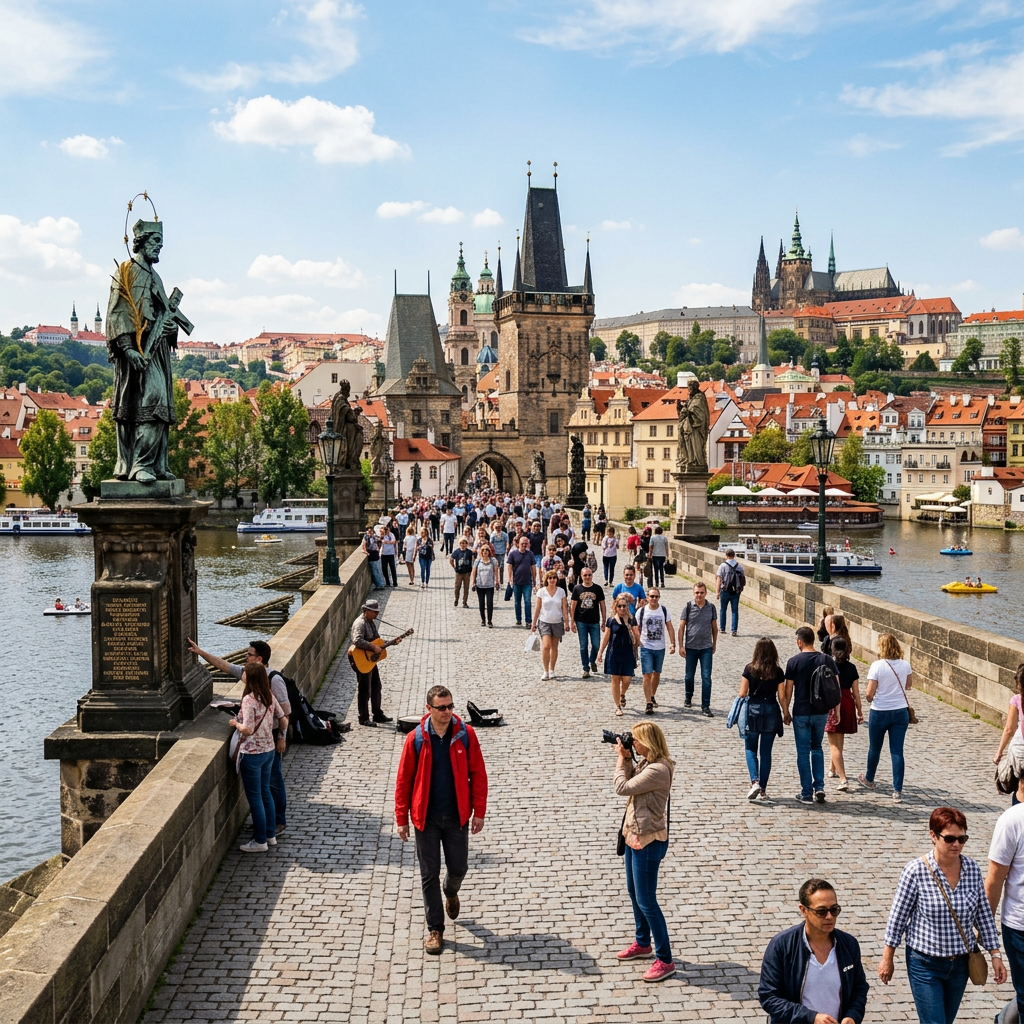
Prague is one of Europe’s most beautiful and best-preserved cities – a fairy-tale skyline of Gothic spires, Baroque domes, and a medieval castle complex rising above the Vltava River, almost entirely untouched by the bombing that levelled so much of the rest of the continent during the Second World War. It’s a city of dramatic history – the Holy Roman Empire, the Habsburgs, two world wars, four decades of communism, and the Velvet Revolution have all left their mark – and today it pairs that history with some of the best and cheapest beer in the world.
📢 Affiliate Disclosure: This post contains affiliate links to Viator. If you book through our links, The Wandering Adventurer earns a small commission at no extra cost to you. Thank you for supporting independent travel content!
This guide covers the top things to do in Prague – with Viator booking links, entry costs, transport, addresses, and insider tips for every attraction.
🗺️ Quick Book: Top Prague Experiences
| Experience | From | Book |
|---|---|---|
| 🏰 Old Town, Medieval Underground & Dungeon Tour— Best Seller | $25 | Viator |
| ⛪ Skip-the-Line Prague Castle Ticket | $35 | Viator |
| ⛴ Best of Prague: Guided Tour & Vltava Cruise with Czech Lunch | $95 | Viator |
| 🍺 Prague Food & Beer Tour: 10 Year Anniversary Edition | $89 | Viator |
| 💀 Kutná Hora & Bone Church Day Trip by Train | $75 | Viator |
💡 Prague Castle and the Kutná Hora day trip get busy in peak season — book as soon as your dates are confirmed.
⛪ 1. Prague Castle & St Vitus Cathedral
🕐 Time needed: 3–4 hours | 💶 Cost: Circuit B ≈420 CZK (~$18); grounds free | 🚌 Tram: Prazsky hrad (tram 22/23) | 📍 Address: Prague Castle, 119 08 Prague 1
Prague Castle is, by Guinness World Records, the largest ancient castle complex on earth – a sprawling fortress-city on a hill above the Vltava that has been the seat of Czech rulers since the 9th century. Within its walls stands St Vitus Cathedral, a soaring Gothic masterpiece begun in 1344 and only completed in 1929, whose stained-glass windows (including one designed by Art Nouveau master Alphonse Mucha) and Wenceslas Chapel are among the finest in Europe. The Old Royal Palace, the Golden Lane (a row of tiny 16th-century houses, one of which Franz Kafka briefly used as a writing studio), and St George’s Basilica round out the complex.
💡 Insider Tip: The castle grounds are free to enter – only the interiors (Circuit A or B tickets) require a paid ticket. Arrive right at opening (9am) to see the Changing of the Guard without crowds, and to beat the tour groups into St Vitus Cathedral.
🎟 Book Skip-the-Line Prague Castle Tickets via Viator
🌉 2. Charles Bridge
🕐 Time needed: 45 min–1.5 hours | 💶 Cost: Free to walk; tower climb ≈250 CZK | 🚌 Tram: Malostranské náměstí | 📍 Address: Karlův most, 110 00 Prague 1
Charles Bridge – commissioned by Holy Roman Emperor Charles IV in 1357 to replace an earlier bridge destroyed by flood – is Prague’s most iconic structure, lined on both sides with 30 Baroque statues of saints, most now replicas with the originals preserved in the National Museum. Crossing it on foot, with the castle rising on one side and the Old Town’s spires on the other, is one of the essential Prague experiences, though it becomes extremely crowded with vendors, caricature artists, and tour groups by mid-morning.
💡 Insider Tip: Cross before 8am or after 9pm for a genuinely peaceful experience – the difference between dawn and midday on this bridge is dramatic. Touching the statue of St John of Nepomuk is said to guarantee a return trip to Prague, a tradition that has worn the bronze relief smooth and shiny.
🕰️ 3. Old Town Square & the Astronomical Clock
🕐 Time needed: 2–3 hours | 💶 Cost: Free to explore; guided tour from $25 | 🚇 Metro: Staroměstská (Line A) | 📍 Address: Staroměstské nám., 110 00 Prague 1
Old Town Square is the beating heart of medieval Prague – ringed by the twin Gothic spires of Týn Church, the pastel Baroque facades of former merchant houses, and the Old Town Hall, home to the Prague Astronomical Clock. Installed in 1410, it is the oldest astronomical clock in the world still operating, and every hour on the hour it puts on a small mechanical show: a procession of the Twelve Apostles appears in two little windows while a skeletal figure of Death tolls a bell.
💡 Insider Tip: The hourly show is genuinely brief and slightly underwhelming in isolation – what makes it worthwhile is the atmosphere of the square itself while you wait. A guided tour that includes the medieval underground beneath the Old Town – the original ground level of the city, buried when Prague was raised to prevent flooding – is one of the most surprising and popular experiences in Prague.
🎟 Book the Old Town, Medieval Underground & Dungeon Tour via Viator
✡️ 4. The Jewish Quarter (Josefov)
🕐 Time needed: 2–3 hours | 💶 Cost: Jewish Museum ticket ≈500 CZK (~$22); guided tour from $65 | 🚇 Metro: Staroměstská (Line A) | 📍 Address: Josefov, 110 00 Prague 1
Josefov is one of the best-preserved Jewish quarters in Europe, precisely because Hitler intended to turn it into a “museum of an extinct race” and so left its synagogues standing while deporting its community. Today it is a profoundly moving place: the Old-New Synagogue, Europe’s oldest active synagogue (built around 1270), the Old Jewish Cemetery with its 12,000 crowded, tilting gravestones stacked in layers over centuries, and the Pinkas Synagogue, whose walls are inscribed with the names of nearly 80,000 Czech Holocaust victims.
💡 Insider Tip: A guided tour is genuinely worth it here – the history is dense and layered, and a good guide transforms what could be a confusing sequence of buildings into a coherent and moving narrative. Modest dress is expected inside the synagogues.
⛴️ 5. A Vltava River Cruise
🕐 Time needed: 1–3 hours | 💶 Cost: From $95 (with lunch & walking tour) | 🚌 Getting there: Departs from central Prague piers along the riverbank | 📍 Departure point: Náměstí Republiky area, central Prague
Seeing Prague Castle, Charles Bridge, and the city’s skyline of spires from the water is a genuinely different and beautiful perspective on the city. A cruise along the Vltava takes in the National Theatre, the Dancing House, and Vyšehrad depending on the route, and pairs especially well with a walking tour and lunch to make a complete half-day introduction to the city.
💡 Insider Tip: The Best of Prague tour (4,168 reviews) combines a guided walk through the Castle district and Old Town with a river cruise and an authentic Czech lunch – an efficient way to cover the essentials on your first day. Evening and dinner cruises are especially atmospheric once the castle and bridges are illuminated.
🎟 Book the Best of Prague Guided Tour & Vltava Cruise via Viator
🏰 6. Lesser Town (Malá Strana) & Petřín Hill
🕐 Time needed: 2–3 hours | 💶 Cost: Free to explore; Petřín funicular ≈ same fare as public transport (≈30 CZK) | 🚌 Tram: Malostranské náměstí | 📍 Address: Malá Strana, 118 00 Prague 1
Malá Strana – the Lesser Town, clustered beneath the castle on the west bank of the Vltava – is one of Prague’s most beautiful and least crowded historic neighbourhoods: cobbled lanes, Baroque palaces (many now embassies), and the magnificent St Nicholas Church, whose dome dominates the district’s skyline. Above it rises Petřín Hill, crowned with a scaled-down 1891 replica of the Eiffel Tower, the Petřín Lookout Tower, which offers one of the best panoramic views in the city.
💡 Insider Tip: Take the funicular up Petřín Hill (covered by a standard public transport ticket) and walk down through the orchards and rose gardens – spectacular in blossom season (April) and during autumn colour. The John Lennon Wall, covered in decades of graffiti and lyrics since Lennon’s death in 1980, is a short walk from the base of the hill.
🏰 7. Vyšehrad
🕐 Time needed: 1.5–2.5 hours | 💶 Cost: Free (fortifications & park); basilica ≈60 CZK | 🚇 Metro: Vyšehrad (Line C) | 📍 Address: V Pevnosti 159/5b, 128 00 Prague 2
Vyšehrad – a fortified hilltop above the Vltava, south of the city centre – is, according to Czech legend, the original seat of the earliest Czech rulers, predating even Prague Castle. Far quieter than the castle district, it offers some of the best views over the river and city skyline, the twin-spired Basilica of St Peter and St Paul, and the Vyšehrad Cemetery, the resting place of Czech cultural giants including composer Antonín Dvořák.
💡 Insider Tip: Vyšehrad is one of Prague’s best-kept secrets – genuinely peaceful even in peak season, with views arguably as good as the castle’s. Come at sunset for a spectacular, nearly crowd-free view over the river and city.
🍺 8. Czech Beer & Food Tour
🕐 Time needed: 3–3.5 hours | 💶 Cost: From $89 incl. food & drinks | 🚌 Getting there: Meets in central Prague | 📍 Meeting point: Central Prague, confirmed at booking
The Czech Republic has the highest beer consumption per capita in the world, and Prague is where that culture is at its most concentrated – traditional pubs (hospody) serving Pilsner Urquell, Budweiser Budvar (the original Budweiser, entirely unrelated to the American beer), and small-batch craft brews at prices that remain remarkably low by Western European standards. A guided food and beer tour moves between historic pubs and hidden local spots, pairing tastings with classic Czech dishes.
💡 Insider Tip: Learn to say “na zdraví” (cheers) and always make eye contact when toasting – a genuine Czech custom. The 10-Year Anniversary edition of the Prague Food & Beer Tour (1,096 reviews) is one of the most consistently well-reviewed food experiences in the city.
🎟 Book the Prague Food & Beer Tour via Viator
🕺 9. The Dancing House & New Town
🕐 Time needed: 1–2 hours | 💶 Cost: Free to view exterior; rooftop bar entry varies | 🚌 Tram: Jiráskovo náměstí | 📍 Address: Jiráskovo nám. 1981/6, 120 00 Prague 2
The Dancing House (Tančicí dům), designed by Frank Gehry and Vlado Miluñić and completed in 1996, is Prague’s most famous piece of contemporary architecture – two intertwined towers, one glass and curving, one solid, that appear to be caught mid-dance, nicknamed “Fred and Ginger” after Astaire and Rogers. It stands out dramatically against the surrounding Baroque and Art Nouveau streetscape of New Town (Nové Město), which despite its name dates largely from the 14th century and includes Wenceslas Square, the site of the 1989 Velvet Revolution protests.
💡 Insider Tip: The rooftop bar atop the Dancing House offers one of the best panoramic views in Prague, arguably better than more famous viewpoints since it includes the building’s own striking silhouette in the foreground of river shots.
💀 10. Kutná Hora & the Bone Church
🕐 Time needed: Full day (7–8 hours) | 💶 Cost: From $75 incl. train & entry fees | 🚂 Getting there: Train from Prague’s Main Station, ~1 hour | 📍 Meeting point: Prague Main Railway Station
Kutná Hora, an hour east of Prague by train, is a UNESCO World Heritage medieval town that grew fabulously wealthy from silver mining in the 13th and 14th centuries – wealth reflected in the soaring Gothic Cathedral of St Barbara, one of the most beautiful churches in Central Europe. But the town’s most famous attraction is the Sedlec Ossuary – the “Bone Church” – a small Gothic chapel whose interior is entirely decorated with the artistically arranged bones of an estimated 40,000 to 70,000 people, including an enormous chandelier said to contain every bone in the human body.
💡 Insider Tip: Photography inside the ossuary is often restricted or banned entirely – check current rules before you go, as policies have changed periodically. Combine the trip with St Barbara’s Cathedral and a walk through Kutná Hora’s own attractive medieval centre, which most day-trippers skip in their rush to see the bones.
🎟 Book the Kutná Hora & Bone Church Day Trip via Viator
🍽️ What to Eat & Drink in Prague
- Svíčková – Braised beef sirloin in a creamy root vegetable sauce, served with bread dumplings (knedlíky), a spoonful of cranberry sauce, and whipped cream. One of the great Czech comfort dishes.
- Guláš – A rich, paprika-spiced beef stew, milder and thicker than its Hungarian namesake, invariably served with bread dumplings to soak up the sauce.
- Trdelník – A cylindrical pastry wrapped around a spit, grilled over coals, and rolled in sugar and cinnamon, often filled with ice cream. Genuinely delicious, though be aware it’s a Prague tourist-street invention rather than a historic Czech dish.
- Chlebíčky – Open-faced sandwiches on a slice of baguette, elaborately topped with combinations like ham, egg, potato salad, and pickles. A Czech deli staple, best from a local sandwich shop rather than a tourist cafe.
- Czech beer – Pilsner Urquell (the original pilsner, invented in nearby Plzeň in 1842) and Budweiser Budvar are the two great Czech lager traditions. A half-litre (“velké pivo”) in a traditional pub remains one of the great bargains of European travel.
💡 Practical Tips for Prague
- Currency: The Czech Republic uses the Czech koruna (CZK), not the euro – some tourist-facing businesses accept euros but at poor exchange rates, so pay in koruna where possible.
- Getting around: Prague’s metro, tram, and bus network is cheap, efficient, and covers the whole city – a 30-minute ticket costs about 30 CZK, a 24-hour pass about 120 CZK.
- Best time to visit: April–May and September–October offer pleasant weather and smaller crowds than peak summer. December’s Christmas markets are magical but very crowded.
- Watch for cobblestones: Much of the historic centre is cobbled and can be slippery, especially around the castle and Charles Bridge – wear proper walking shoes.
- Beware restaurant scams near tourist sites: A small number of restaurants near Old Town Square and Charles Bridge have a history of inflating bills for tourists – check menus for prices before ordering, and always review your bill.
🎟️ Browse all Prague experiences: All Prague tours and activities on Viator
❓ Frequently Asked Questions About Visiting Prague
How many days do you need in Prague?
Three full days covers Prague Castle, the Old Town, Charles Bridge, and the Jewish Quarter comfortably. A fourth day allows Vyšehrad and a slower pace through Malá Strana, and a fifth for the Kutná Hora day trip.
Do you need to book Prague Castle tickets in advance?
It’s worth booking ahead in peak season (May–September), especially for the interiors (Circuit A or B) — the castle grounds themselves are free and always open, but ticketed areas like St Vitus Cathedral’s interior and the Old Royal Palace can have long queues without a pre-booked ticket.
Is the Kutná Hora day trip worth it?
Yes – the Sedlec Ossuary is a genuinely unique sight found almost nowhere else in the world, and St Barbara’s Cathedral and the town’s own medieval centre round out a rewarding full day. It’s about an hour away by train, making it an easy add-on if you have four or more days in Prague.
Is Prague expensive?
Prague remains one of the more affordable major European capitals, particularly for food and beer, though prices in the immediate tourist zones around Old Town Square and Charles Bridge run noticeably higher than a few streets away. Museum and castle admission is generally cheaper than equivalent sights in Western Europe.
What’s the best way to get from Prague Airport into the city centre?
The Airport Express (AE) bus runs directly to Prague’s Main Railway Station in about 35 minutes for a low fixed fare; public bus 119 connects to the metro at Nádraží Veleslavín for an even cheaper option. A taxi or rideshare takes 25–35 minutes depending on traffic and costs more but is convenient with luggage.
Plan the Rest of Your Prague Trip
Prague pairs beautifully with Vienna for a Central European city break — check out our other guides for where to head next.
This post contains affiliate links to Viator. The Wandering Adventurer may earn a small commission if you book through our links, at no extra cost to you.
Leave a Reply