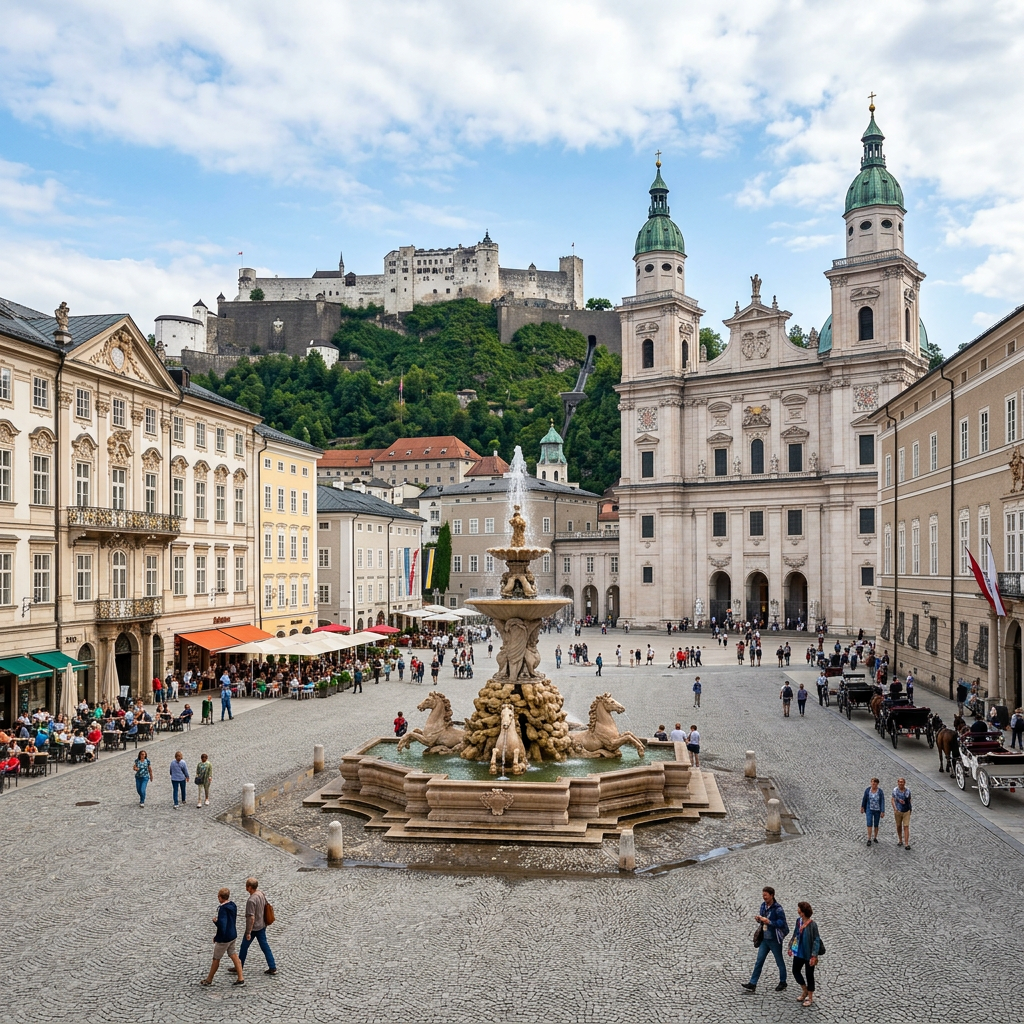
Salzburg is one of the most beautiful small cities in the world – a compact Baroque masterpiece set at the foot of the Alps, on the banks of the Salzach River, where the history of Western classical music, the legacy of Mozart, and the echoes of the Sound of Music converge in a city that has been remarkably well-preserved and deeply loved for centuries. The Altstadt (old town) is a UNESCO World Heritage Site and one of the finest preserved Baroque urban ensembles in Europe. And Hohensalzburg Fortress, looming above it all, is the largest fully preserved medieval castle in the German-speaking world.
📢 Affiliate Disclosure: This post contains affiliate links to Viator. If you book through our links, The Wandering Adventurer earns a small commission at no extra cost to you. Thank you for supporting independent travel content!
This guide covers the top things to do in Salzburg – with Viator booking links, costs, transport info, addresses, and insider tips for every attraction.
🗓️ Quick Book: Top Salzburg Experiences
| Experience | Duration | Price from | Book |
|---|---|---|---|
| 🎵 The Original Sound of Music Tour (Best Seller) | 4 hrs | $89 | Viator |
| 🏞️ Hallstatt Half-Day Tour from Salzburg | 5.5 hrs | $101 | Viator |
| ⛰️ Eagle’s Nest Berchtesgaden Tour | 4.5 hrs | $125 | Viator |
| 🎹 Palace Concert at Marble Hall, Mirabell | 1.75 hrs | $46 | Viator |
| 🧁 Austrian Apple Strudel Cooking Class | 1.5 hrs | $71 | Viator |
💡 Tip: The Sound of Music Tour is Salzburg’s most popular experience – book in advance, especially in summer.
🏰 1. Hohensalzburg Fortress
🕐 Time needed: 2–3 hours | 💶 Cost: EUR 15 adults (funicular included) | 🚌 Getting there: Funicular from Festungsgasse, Altstadt | 📍 Address: Monchsberg 34, 5020 Salzburg, Austria
Hohensalzburg Fortress is the largest and best-preserved medieval castle in the German-speaking world – a massive fortification looming 120 metres above Salzburg that has dominated the city’s skyline since 1077. The fortress is extraordinarily intact, with original state rooms, a small garrison museum, and most importantly the panoramic views from the ramparts – the Salzach River below, the Altstadt’s Baroque towers and copper domes, and the Bavarian Alps receding to the horizon on clear days. It is genuinely one of the finest fortress experiences in Europe.
💡 Insider Tip: The funicular ticket includes fortress admission; the walk up the hill (about 20 minutes from the Altstadt) is free and gives different views as you ascend. Arrive at opening (9am) to have the fortress largely to yourself before the tour groups arrive. The view from the northern rampart at sunset, with the Baroque city and river below turning golden, is among the finest in Austria.
🎟️ Book the Salzburg Old Town Walking Tour via Viator
🎵 2. The Sound of Music Tour
🕐 Time needed: 4 hours | 💶 Cost: From $89 | 🚌 Getting there: Departs from central Salzburg; hotel pick-up available | 📍 Start: Mirabellplatz, 5020 Salzburg
The Sound of Music tour is Salzburg’s single most popular attraction – a half-day coach and walking tour visiting the real locations from the 1965 film: the Mirabell Gardens where Maria and the children danced around the Do-Re-Mi fountain, the gazebo at Hellbrunn Palace, the Mondsee Cathedral where the wedding was filmed, and the meadows below Berchtesgaden where the opening sequence was shot. Even for visitors with no attachment to the film, the tour is an excellent introduction to the Salzburg region’s extraordinary Alpine scenery and the real Von Trapp family story.
💡 Insider Tip: The original Von Trapp family villa is visible from outside but not open to public tours – it is now a hotel. The Mirabell Gardens are freely accessible and worth visiting independently regardless of whether you take the tour – the Do-Re-Mi steps and fountain are genuinely beautiful in the morning light.
🎟️ Book the Original Sound of Music Tour via Viator
🏛️ 3. Salzburg Altstadt (Old Town)
🕐 Time needed: 2–3 hours | 💶 Cost: Free to walk | 🚌 Getting there: Central Salzburg; most hotels in walking distance | 📍 Address: Getreidegasse, 5020 Salzburg
The Salzburg Altstadt is one of the finest preserved Baroque city centres in the world and a UNESCO World Heritage Site. The narrow lanes of Getreidegasse (where Mozart was born at No. 9) are lined with wrought-iron guild signs, passage courtyards, and medieval buildings. The Residenzplatz is the finest Baroque square in Austria, with the Residenz Palace, the Salzburg Cathedral, and the New Residence forming three sides of a perfectly proportioned Baroque ensemble. The whole area is extraordinarily dense with history, architecture, and atmosphere.
💡 Insider Tip: The old town rewards slow exploration of its courtyards and passages (Durchhaeuser) – Salzburg’s historic buildings open into interconnected interior courtyards that are invisible from the street. The Alter Markt (old market square) with its historic pharmacy and the narrow lanes off Kaigasse are among the most beautiful and least crowded parts of the Altstadt.
🎟️ Book the Salzburg Old Town Walking Tour via Viator
🎼 4. Mozart’s Birthplace and Residence
🕐 Time needed: 1–1.5 hours each | 💶 Cost: Birthplace EUR 13; Residence EUR 12; combo EUR 20 | 🚌 Getting there: Altstadt; central walking distance | 📍 Address: Birthplace: 9 Getreidegasse; Residence: 8 Makartplatz
Wolfgang Amadeus Mozart was born in Salzburg in 1756 and spent the first 25 years of his life here before departing permanently for Vienna in 1781. The city maintains two museums: the Birthplace (Geburtshaus) in Getreidegasse, occupying the third-floor apartment where he was born, and the Mozart Residence (Wohnhaus) across the river, the larger family home from 1773 to 1780. Both are genuinely interesting for anyone with any knowledge of his music; the Birthplace has extraordinary original instruments and artefacts.
💡 Insider Tip: The Mozart Residence (across the Salzach River in the Neustadt) is significantly less crowded than the Birthplace and has better-curated exhibits – if choosing between the two, the Residence gives the fuller picture of Mozart’s life in Salzburg. Combine with the Mirabell Gardens (directly adjacent) for a full Mozart morning.
🎟️ Book the Mozart & Mirabell Gardens Walking Tour via Viator
🌺 5. Mirabell Palace and Gardens
🕐 Time needed: 1 hour | 💶 Cost: Gardens free; palace interior limited access | 🚌 Getting there: Mirabellplatz, Neustadt | 📍 Address: Mirabellplatz 4, 5020 Salzburg
Mirabell Palace was built in 1606 by the Prince-Archbishop Wolf Dietrich von Raitenau for his mistress and their 15 children, and the gardens are among the most beautiful formal gardens in Austria. The parterre gardens with their ornamental flowerbeds, fountains, and statues are at their finest in summer and autumn. The palace’s Marble Hall – where Mozart performed as a child – is one of the most beautiful Baroque interiors in Salzburg and is still used for concerts and civil weddings.
💡 Insider Tip: The Dwarf Garden at the side of Mirabell (statues of dwarfs in various poses, a 17th-century princely whim) is one of Salzburg’s most charming and oddly overlooked features. The view of Hohensalzburg Fortress from the main garden terrace is one of the most photographed in the city. Gardens are free and open daily – the morning light is exceptional.
🎟️ Book the Sound of Music Tour (includes Mirabell) via Viator
⛪ 6. Salzburg Cathedral and the Domquartier
🕐 Time needed: 1.5–2 hours | 💶 Cost: Cathedral free; Domquartier EUR 15 | 🚌 Getting there: Altstadt; central walking distance | 📍 Address: Domplatz 1a, 5020 Salzburg
Salzburg Cathedral (the Dom) is the finest Baroque church in Austria – a magnificent early 17th-century building with a white marble facade, twin flanking towers, and an interior of extraordinary painted ceilings, gilded altars, and the massive baptismal font in which Mozart was baptised in 1756. The adjacent Domquartier museum complex – a connected circuit of museums through the Residenz Palace and Cathedral via an elevated bridge passage – provides the fullest picture of Salzburg’s extraordinary ecclesiastical and princely heritage.
💡 Insider Tip: The Cathedral is free to enter during opening hours (check for service times). The Domquartier museum circuit includes the Residenz state rooms and gallery, the Archbishop’s apartments, and the elevated passage between buildings – one of the finest museum experiences in Salzburg and the best way to understand the power and wealth of the prince-archbishops who built the city.
🎟️ Book the Salzburg Old Town Walking Tour via Viator
💦 7. Hellbrunn Palace and Trick Fountains
🕐 Time needed: 2 hours | 💶 Cost: EUR 14 adults | 🚌 Getting there: 4km south of Salzburg; bus 25 or bicycle | 📍 Address: Furstenbrunngasse 37, 5020 Salzburg
Hellbrunn Palace is one of the most entertaining and unusual attractions in Austria – a 17th-century summer residence built by Prince-Archbishop Markus Sittikus with an extraordinary system of trick fountains concealed in the garden paths, grottoes, and stone tables. Guided tours lead visitors through the gardens activating hidden water jets that suddenly drench unsuspecting guests at the stone throne or various garden ornaments. The trick fountains are genuinely hilarious and have been surprising visitors since 1619. The gazebo from the Sound of Music is also on the grounds.
💡 Insider Tip: Trick fountain tours are guided only and run frequently – book in advance online if visiting in summer. Wear shoes and clothes you don’t mind getting wet (the archbishop’s throne is still a guaranteed soaking). A river cruise from the Old Town to Hellbrunn is one of the most enjoyable ways to arrive – the Salzach views are beautiful.
🎟️ Book the River Cruise to Hellbrunn Palace via Viator
🚣 8. The Salzach River Walk and Neustadt
🕐 Time needed: 1–2 hours | 💶 Cost: Free | 🚌 Getting there: Any of the river bridges from the Altstadt | 📍 Start: Staatsbrucke (main bridge), 5020 Salzburg
The walk along the Salzach River – from the Staatsbrucke south to the Mozartsteg footbridge and back along the opposite bank – is one of the most pleasant urban walks in Austria. The river view of the Altstadt, with Hohensalzburg Fortress rising above the copper-domed Cathedral and the Baroque facades, is the classic Salzburg panorama. The Neustadt (new town) on the north bank has a different atmosphere from the Altstadt – quieter, more residential, with excellent independent cafes and the Mozart Residence.
💡 Insider Tip: The Steingasse (Stone Lane) on the north bank of the Salzach is one of Salzburg’s most atmospheric and photogenic medieval streets – a narrow cobblestone lane of medieval houses that somehow survived the Baroque rebuilding of the city. It is most beautiful in early morning before foot traffic. The river views at sunset, looking back at the lit Altstadt, are exceptional.
🎟️ Book the Salzach River Cruise via Viator
🎹 9. Mozart Concert in a Baroque Palace
🕐 Time needed: 1.75 hours | 💶 Cost: From $46 | 🚌 Getting there: Mirabell Palace Marble Hall, Mirabellplatz | 📍 Address: Mirabellplatz 4, 5020 Salzburg
Attending a Mozart concert in one of Salzburg’s Baroque palaces is one of the quintessential Salzburg experiences – musicians in 18th-century court costume performing Mozart’s chamber works, symphonies, or operatic arias in the very city where he was born and grew up. The Marble Hall concert at Mirabell Palace – the same room where Mozart performed as a child prodigy – is the most intimate and atmospheric venue. This is not a tourist gimmick but a genuinely excellent musical experience; Salzburg has always taken its musical heritage with complete seriousness.
💡 Insider Tip: The Salzburg Festival (late July and August) is one of the world’s great classical music events – tickets for the main opera and orchestral concerts sell out months in advance and cost hundreds of euros. The fringe concerts during Festival season are excellent and significantly more affordable. Book any concert ticket in advance, especially in summer.
🎟️ Book the Salzburg Palace Concert at Mirabell via Viator
⛰️ 10. Berchtesgaden and Eagle’s Nest Day Trip
🕐 Time needed: Full day | 💶 Cost: From $125 guided | 🚌 Getting there: 30km south of Salzburg; guided tours depart from central Salzburg | 📍 Address: Kehlsteinhaus, 83471 Berchtesgaden, Germany
The Eagle’s Nest (Kehlsteinhaus) is one of the most dramatically situated buildings in Europe – a mountain-top teahouse built by Nazi Germany in 1938 as a gift to Adolf Hitler, perched at 1,834 metres on the summit of the Kehlstein above Berchtesgaden. The engineering feat – a brass-fitted elevator rising 124 metres through solid rock to the summit – and the views from the terrace (360-degree Alpine panorama across Germany, Austria, and on clear days as far as Italy) are extraordinary. The surrounding Berchtesgaden National Park is one of the finest Alpine landscapes in Bavaria.
💡 Insider Tip: The Eagle’s Nest is only accessible May–October (road closes in winter). A guided tour from Salzburg that includes the Dokumentation Obersalzberg documentation centre provides important historical context for the visit. Skip-the-line entry is included with guided tours – worth it in peak summer when the special bus to the summit can have long queues.
🎟️ Book the Eagle’s Nest Berchtesgaden Tour via Viator
🧁 What to Eat & Drink in Salzburg
- Wiener Schnitzel – Veal cutlet breaded and pan-fried in clarified butter to a perfect golden crust, served with potato salad and lingonberry jam. The essential dish – Cafe Tomaselli (since 1705) and the Stiftskeller St Peter (the oldest restaurant in Central Europe, established 803 AD) are the historic choices.
- Salzburger Nockerl – A massive, cloud-like sweet soufflé baked in a dome to represent the city’s three hills. Salzburg’s signature dessert and one of the most theatrical dishes in Austrian cooking – it must be eaten within minutes of leaving the oven.
- Mozartkugel – The chocolate and pistachio marzipan ball invented by confectioner Paul Fuerst in 1890. Sold everywhere: the authentic handmade originals from Confiserie Fuerst are in a silver wrapper. The mass-produced varieties in the gold wrapper are not the same thing.
- Apple Strudel – Stretched tissue-thin pastry wrapped around cinnamon apple filling with raisins, served warm with vanilla sauce or ice cream. Available at every cafe; making your own on a cooking class is one of the most enjoyable Salzburg experiences.
- Augustinerbierhaus – A vast, 1621 Augustinian monastery brewery that serves its own unfiltered lager directly from wooden kegs in the monastery’s stone halls – one of the finest beer experiences in Europe and genuinely un-touristy by Salzburg standards.
- Stiegl-Keller – Salzburg’s historic beer terrace high above the Altstadt, with panoramic views over the city rooftops and the fortress above. The Stiegl brewery has been brewing here since 1492.
💡 Practical Tips for Salzburg
- Getting around: The Altstadt is entirely walkable – Salzburg is a compact city and most attractions are within 20 minutes’ walk of each other. The Salzburg Card (available for 24/48/72 hours) covers all public transport and admission to most major attractions – excellent value for a multi-day visit.
- Getting there: Salzburg has its own international airport (15 minutes from the centre). Vienna is 3 hours by train; Munich is 1.5 hours. The train station is 15 minutes’ walk from the Altstadt.
- Best time to visit: May–June and September–October offer the best weather, the most beautiful Alpine light, and manageable crowds. July–August is peak season – busy but beautiful. The Christmas markets (late November–December 24) are among the finest in Europe.
- Day trips: The Salzkammergut lake district (St Wolfgang, Hallstatt) is 45–90 minutes by bus or car – some of the most beautiful Alpine lake scenery in Europe. The Hallstatt Half-Day Tour from Salzburg is the easiest way to visit without a car.
🎟️ Browse all Salzburg experiences: All Salzburg tours and activities on Viator
Plan the Rest of Your Salzburg Trip
Salzburg is one stop on a central European itinerary.
This post contains affiliate links. The Wandering Adventurer may earn a small commission if you book through our links, at no extra cost to you. Thank you for supporting independent travel content!
Leave a Reply