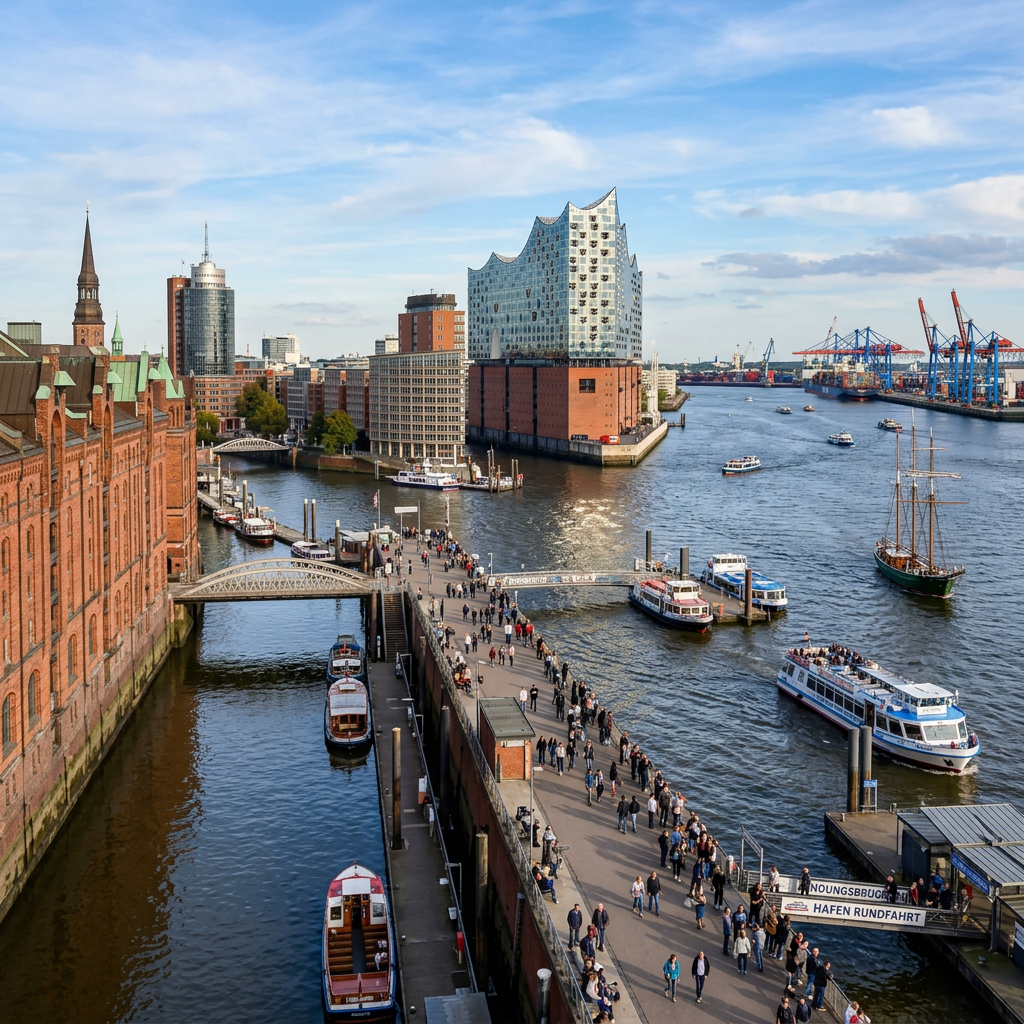
Hamburg is Germany’s great port city – a place built entirely around water, from the UNESCO-listed red-brick warehouses of the Speicherstadt to the wide, glittering Alster lakes at its centre. It’s wealthier and greener than its reputation as a gritty harbour town might suggest, with more bridges than Venice and Amsterdam combined, a genuinely world-class concert hall, and a red-light district that’s as much a piece of living history as it is a nightlife destination. Hamburg rewards visitors who come expecting a serious, characterful city rather than a stopover.
📢 Affiliate Disclosure: This post contains affiliate links to Viator. If you book through our links, The Wandering Adventurer earns a small commission at no extra cost to you. Thank you for supporting independent travel content!
This guide covers the top things to do in Hamburg – with Viator booking links, entry costs, transport, addresses, and insider tips for every attraction.
🗺️ Quick Book: Top Hamburg Experiences
| Experience | From | Book |
|---|---|---|
| 🏛️ The Local Tour of Hamburg Historic Centre, Pay What You Want | Tip-based | Viator |
| ⛴ Hamburg 2-Hour Harbor Cruise | $28 | Viator |
| 💃 Hamburg Reeperbahn Small-Group Walking Tour | $32 | Viator |
| 🌃 Night Cruise — Speicherstadt & Port Illuminated | From $83 | Viator |
| 🏰 Lübeck Day Trip from Hamburg by Train with Private Guide & Lunch | From $381 | Viator |
💡 Harbor cruises and the Reeperbahn tour sell out on weekends in summer — book as soon as your dates are confirmed.
🏛️ 1. Speicherstadt & HafenCity
🕐 Time needed: 2–3 hours | 💶 Cost: Free to explore; guided tour tip-based | 🚇 U-Bahn: Baumwall or Meßberg | 📍 Address: Speicherstadt, 20457 Hamburg
The Speicherstadt is the largest warehouse district in the world built on timber piles – a UNESCO World Heritage Site since 2015, its dense rows of red-brick neo-Gothic warehouses laced with canals (Fleete) that once stored coffee, spices, and Persian carpets for the whole of Europe. Alongside it, HafenCity is one of the largest urban development projects in Europe, transforming former docklands into a striking modern district of glass architecture, waterfront promenades, and public plazas, anchored by the Elbphilharmonie.
💡 Insider Tip: The pay-what-you-want Local Tour of the Historic Centre (1,288 reviews) covers the Old Town, Speicherstadt, and the Elbphilharmonie exterior in a single well-organised walk, and is Hamburg’s most popular introduction to the city. Visit at dusk when the warehouse facades are lit – genuinely one of the most beautiful sights in Northern Germany.
🎟 Book the Local Tour of Hamburg Historic Centre via Viator
🎵 2. The Elbphilharmonie
🕐 Time needed: 45 min–2 hours | 💶 Cost: Plaza free; concert tickets vary | 🚇 U-Bahn: Baumwall, 10-min walk | 📍 Address: Platz der Deutschen Einheit 4, 20457 Hamburg
The Elbphilharmonie, opened in 2017 after a notoriously over-budget and delayed decade-long construction, is now one of the most acoustically celebrated concert halls in the world – a shimmering glass wave-shaped structure rising above a converted brick warehouse on the Elbe. Even without attending a concert, the free public Plaza, an elevated walkway curving around the building’s midsection, offers a spectacular 360-degree panorama over the harbour, HafenCity, and the Speicherstadt.
💡 Insider Tip: Plaza access is free but requires a timed ticket, bookable online or at the on-site ticket counter – same-day tickets are often available, but don’t assume you can simply walk up during peak season. If you can time a concert, the Grand Hall’s acoustics are genuinely extraordinary regardless of your familiarity with classical music.
🚂 3. Miniatur Wunderland
🕐 Time needed: 3–5 hours | 💶 Cost: €20 adults (book direct) | 🚇 U-Bahn: Meßberg or Baumwall | 📍 Address: Kehrwieder 2/4, 20457 Hamburg
Miniatur Wunderland is the largest model railway in the world, and one of Germany’s single most-visited attractions – over 16km of track winding through astonishingly detailed miniature recreations of Hamburg, Scandinavia, the Alps, the USA, and beyond, with day-to-night lighting cycles, moving vehicles, and thousands of tiny figures each engaged in some small drama. It sits inside a genuine Speicherstadt warehouse and regularly draws queues that stretch around the block.
💡 Insider Tip: Tickets must be booked directly through the official Miniatur Wunderland website for a specific timed entry slot – popular slots, especially weekends and school holidays, sell out days or weeks in advance, so book well ahead of your trip. Evening visits (after 6pm) are noticeably quieter than daytime.
⛴ 4. A Hamburg Harbor Cruise
🕐 Time needed: 1–2 hours | 💶 Cost: From $28 | 🚌 Departure: Landungsbrücken, Bridge 1 | 📍 Address: St. Pauli Landungsbrücken, 20359 Hamburg
The Port of Hamburg is one of the largest in Europe, and a harbor cruise is the classic way to see it – gliding past the Speicherstadt’s canals, the futuristic HafenCity waterfront, the Elbphilharmonie, and enormous working container terminals where some of the world’s largest cargo ships dock. Traditional wooden barges (Barkassen) run frequently from the Landungsbrücken piers, with routes adjusted daily depending on tides and harbor traffic.
💡 Insider Tip: Commentary on many of the traditional barge tours is in German only – download the free “RainerAbicht” audio guide app in advance if you want English narration, and bring your own headphones. Sit on the side facing the working docks for the best view of the massive container ships being loaded.
🎟 Book the Hamburg 2-Hour Harbor Cruise via Viator
⛪ 5. St. Michaelis Church (Der Michel)
🕐 Time needed: 1–1.5 hours | 💶 Cost: Church €5; tower €8 (or €10 combined) | 🚇 U-Bahn: Baumwall or Rödingsmarkt | 📍 Address: Englische Planke 1, 20459 Hamburg
St. Michaelis, affectionately known to Hamburgers simply as “Der Michel,” is the city’s most important church and unofficial symbol – an 18th-century Baroque masterpiece whose 132-metre copper spire has served as a landmark for ships entering the harbour for centuries. The lift or 452-step climb up the tower delivers one of the best panoramic views in the city, taking in the Speicherstadt, the Elbe, and on clear days the surrounding countryside.
💡 Insider Tip: Take the lift up rather than the stairs unless you specifically want the climb – it’s faster and the view from the top is identical. Free organ recitals are held periodically during the week; check the schedule posted at the entrance.
💃 6. The Reeperbahn & St. Pauli
🕐 Time needed: 2–3 hours (evening) | 💶 Cost: Guided walking tour from $32 | 🚇 U-Bahn: St. Pauli (U3) | 📍 Address: Reeperbahn, 20359 Hamburg
The Reeperbahn is Hamburg’s most famous street – the heart of the St. Pauli entertainment district since the 17th century, and legally Germany’s designated red-light zone since the 19th. It’s genuinely more layered than that description suggests: this is also where The Beatles played over 270 shows early in their career (commemorated at Beatles-Platz), and the surrounding streets hold live music venues, theatres, and some of Hamburg’s best nightlife alongside the district’s more notorious attractions.
💡 Insider Tip: A guided walking tour genuinely adds context here – the area’s history, gang culture, and Beatles connection are far more interesting with a knowledgeable local guide than wandering solo. Herbertstraße, a single block of the district, is legally off-limits to anyone under 18 and to unaccompanied women; respect the posted barriers.
🎟 Book the Reeperbahn Small-Group Walking Tour via Viator
🐟 7. The Hamburg Fish Market (Fischmarkt)
🕐 Time needed: 1.5–2.5 hours | 💶 Cost: Free to browse | 🚇 U-Bahn: Landungsbrücken, then a short walk | 📍 Address: Große Elbstraße 9, 22767 Hamburg
The Fischmarkt has operated on the banks of the Elbe since 1703, and today it’s less about buying fish (though you still can) than about the sheer spectacle: market traders bellowing theatrical sales patter over crates of produce, flowers, and seafood, all beginning at the notoriously early hour of 5am (7am in winter) on Sundays only, and running until 9:30am. The historic Fischauktionshalle (Fish Auction Hall) next door often hosts live bands, adding a genuinely surreal after-party atmosphere for Reeperbahn revellers who haven’t yet gone to bed.
💡 Insider Tip: Go early – the market is at its liveliest and most chaotic before 7am, and the best bargains on produce (traders famously give away unsold stock as closing approaches) also come early. It’s a genuinely unique Hamburg tradition worth reorganising your schedule around, even if it means an early Sunday start.
🏛️ 8. Rathaus & the Alster Lakes
🕐 Time needed: 2–3 hours | 💶 Cost: Rathaus tour €5; lakeside walking free | 🚇 U-Bahn: Rathaus or Jungfernstieg | 📍 Address: Rathausmarkt 1, 20095 Hamburg
Hamburg’s City Hall, completed in 1897, is a lavishly ornate neo-Renaissance building with 647 rooms – deliberately built with one more room than Buckingham Palace, a detail Hamburgers still enjoy pointing out. Just beyond it, the Binnenalster and Außenalster lakes form the green, watery heart of the city centre, ringed by promenades, sailing boats, and some of Hamburg’s most expensive real estate; a walk or boat trip around them is one of the best free things to do in the city.
💡 Insider Tip: The Rathaus interior can only be seen on a guided tour with limited daily slots, so check the schedule at the entrance early in the day. Rent a pedal boat or take the Alster steamer for a relaxed way to see the lake from the water, especially lovely at golden hour.
🌃 9. A Nighttime Harbor & Speicherstadt Cruise
🕐 Time needed: 90 minutes | 💶 Cost: From $83 | 🚌 Departure: Landungsbrücken piers | 📍 Address: St. Pauli Landungsbrücken, 20359 Hamburg
Seeing the Speicherstadt and the harbor after dark, when the warehouse facades and bridges are fully illuminated and reflected in the canals, is a completely different and arguably more atmospheric experience than the daytime cruise – the working port’s industrial lighting combined with the warm glow of the historic warehouses creates a genuinely striking nighttime cityscape.
💡 Insider Tip: This is a great way to start an evening before heading to the Reeperbahn or St. Pauli, since the cruise departs from the same Landungsbrücken area. Dress warmly even in summer – the Elbe gets genuinely cold after sunset, and most boats are open-air or only partially covered.
🎟 Book the Night Cruise via Viator
🏰 10. Lübeck Day Trip
🕐 Time needed: Full day (7–8 hours) | 💶 Cost: From $381 (private tour, price varies by group size) | 🚂 Getting there: Train from Hamburg Hauptbahnhof, ~45 min | 📍 Meeting point: Central Hamburg, confirmed at booking
Lübeck, less than an hour from Hamburg by train, was the historic capital of the medieval Hanseatic League and remains one of the best-preserved Hanseatic cities in Europe, its entire old town a UNESCO World Heritage Site. The iconic twin-turreted Holstentor gate, the soaring red-brick Marienkirche (which directly inspired the “brick Gothic” style found across the Baltic), and the winding lanes of gabled merchant houses make it one of the most rewarding easy day trips from Hamburg – and it’s also the birthplace of marzipan as a Lübeck specialty, with the historic Niederegger cafe still serving it in the same building since 1806.
💡 Insider Tip: Lübeck is genuinely easy to visit independently by train if you’d rather skip a guided tour – trains run roughly hourly and the old town is compact and walkable from the station. If you do want a guide, book well ahead, as it’s a smaller-scale, private-tour product with limited daily capacity.
🎟 Book the Lübeck Day Trip via Viator
🍽️ What to Eat & Drink in Hamburg
- Fischbrötchen – A humble but essential Hamburg staple: a fish fillet (often herring or matjes) in a bread roll with onions and remoulade, sold from stalls all along the harbourfront and at the Fischmarkt. The definitive Hamburg street food.
- Franzbrötchen – A distinctly Hamburg pastry: a cinnamon-swirled, slightly flattened bun somewhere between a croissant and a cinnamon roll, found in every bakery in the city and virtually nowhere else in Germany.
- Labskaus – A hearty sailor’s dish of corned beef, mashed potato, and beetroot mashed together into a pink hash, traditionally topped with a fried egg, pickled gherkin, and rollmops. An acquired taste, but a genuine piece of maritime history.
- Aalsuppe – A traditional Hamburg soup that, confusingly, originally contained no eel at all (the name likely derives from a Low German word for “everything,” referring to its mix of ingredients) – a sweet-and-sour broth of dried fruit, vegetables, and often ham or bacon.
- Alsterwasser & Astra beer – Alsterwasser (a beer-and-lemonade shandy, named for the Alster lakes) is a refreshing summer staple, while Astra, brewed in St. Pauli since 1832, is Hamburg’s beloved local beer, closely associated with the Reeperbahn and FC St. Pauli football club.
💡 Practical Tips for Hamburg
- Getting around: Hamburg’s U-Bahn and S-Bahn network is extensive, clean, and easy to navigate — a Hamburg Card covers public transport plus discounted entry to many attractions and museums.
- Best time to visit: May–September for the warmest, driest weather; Hamburg is genuinely rainy much of the year, so pack a waterproof layer regardless of season.
- Book Miniatur Wunderland well in advance: This is one of Germany’s most popular attractions and timed slots sell out weeks ahead in peak season and school holidays.
- The Reeperbahn is generally safe: Like any nightlife district, use normal city sense late at night, but the area is well-policed and heavily touristed rather than genuinely dangerous.
- Sunday shopping is limited: Most shops are closed on Sundays by German law, though the Fischmarkt and some HafenCity cafes are exceptions — plan grocery and retail errands accordingly.
🎟️ Browse all Hamburg experiences: All Hamburg tours and activities on Viator
❓ Frequently Asked Questions About Visiting Hamburg
How many days do you need in Hamburg?
Two full days covers the Speicherstadt, Elbphilharmonie, Miniatur Wunderland, and the Reeperbahn comfortably. A third day allows the Rathaus, Alster Lakes, and St. Michaelis at a slower pace, and a fourth for the Lübeck day trip.
Do you need to book Miniatur Wunderland tickets in advance?
Yes, essentially always — this is one of Germany’s most visited attractions, and timed entry slots sell out days to weeks ahead, especially on weekends and during school holidays. Book directly through the official website as early as possible.
Is the Reeperbahn safe to visit?
Yes, generally — it’s a heavily touristed, well-policed nightlife and entertainment district rather than a genuinely dangerous area. Ordinary city awareness at night is sensible, and note that Herbertstraße specifically is legally restricted to those over 18 and off-limits to unaccompanied women.
Is the Lübeck day trip worth it?
Yes — Lübeck’s UNESCO-listed old town is genuinely one of the best-preserved medieval Hanseatic cities in Europe, and it’s under an hour away by direct train, making it an easy and rewarding add-on if you have four or more days in Hamburg.
What’s the best way to get from Hamburg Airport into the city centre?
The S-Bahn (S1) runs directly from the airport to the city centre in about 25 minutes and is the cheapest, most reliable option. A taxi takes 20–30 minutes depending on traffic and costs considerably more.
Explore More of Germany
Hamburg is one gateway to Germany — check out our other German destination guides for where to head next.
This post contains affiliate links to Viator. The Wandering Adventurer may earn a small commission if you book through our links, at no extra cost to you.
Leave a Reply