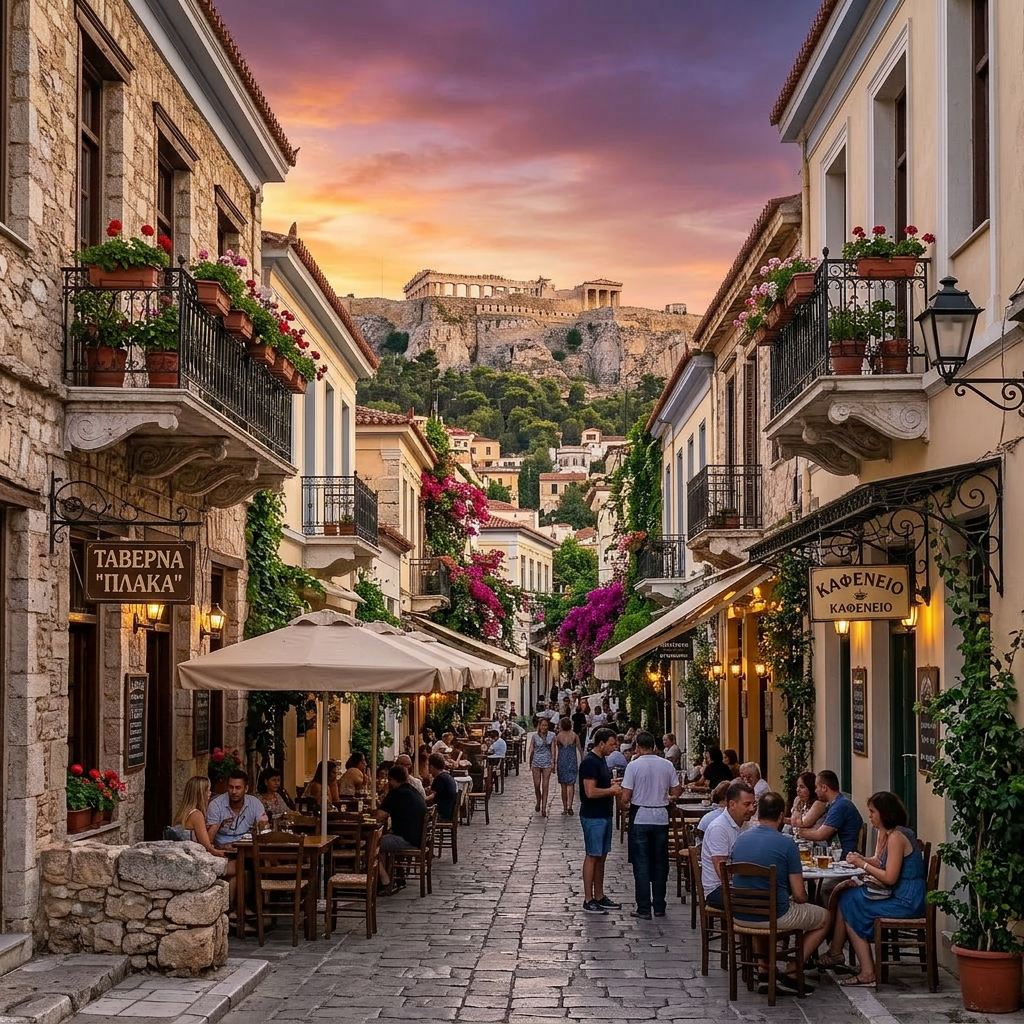
Athens is one of the most extraordinary cities on earth — a place where 2,500 years of human civilisation press themselves into your daily life with extraordinary force. You can eat breakfast in a café, look up, and see the Parthenon on its rocky hill above you, as it has stood above this city for nearly two and a half millennia. Athens is gritty, chaotic, endlessly fascinating, and absolutely unlike anywhere else in Europe.
📢 Affiliate Disclosure: This post contains affiliate links to Viator and Klook. If you book through our links, The Wandering Adventurer earns a small commission at no extra cost to you. Thank you for supporting independent travel content!
This guide covers the top things to do in Athens — from the iconic ancient sites to the best neighbourhoods, food experiences, and day trips — with Viator and Klook booking links so you can skip the queues and make the most of every hour in this remarkable city.
🗓 Quick Book: Top Athens Experiences
| Experience | Best For | Booking Links |
|---|---|---|
| 🏛️ Acropolis Tickets & Guided Tours | First-time visitors | Check Viator → · Check Klook → |
| 🏺 Acropolis Museum Tours | Greek history | Check Viator → · Check Klook → |
| 🏛️ Ancient Agora Tickets & Tours | Ancient Athens | Check Viator → · Check Klook → |
| 🏘️ Plaka & Athens Walking Tours | Local neighborhoods | See Viator Tours → |
| 🏺 National Archaeological Museum Tours | Ancient artifacts | See Viator Tours → |
| 🌅 Athens Tour with Lycabettus Sunset | Panoramic views | See This Tour → |
| 🚶 Ancient Athens Historical Tours | Multiple ancient sites | See Viator Tours → |
| 🍴 Athens Food Tours | Greek food | Check Viator → · Check Klook → |
| 🌅 Cape Sounion Day Trips | Easy day trip | Check Viator → · Check Klook → |
| ⛵ Greek Islands Day Cruises | Island hopping | Check Viator → · Check Klook → |
💡 Planning Tip: You don’t need to book everything in Athens ahead of time. If the Acropolis is a must-do, check your preferred date and entry time first, then plan the rest of your sightseeing around it.
🏛️ 1. The Acropolis & the Parthenon
⏱️ Time needed: 2–3 hours | 📍 Area: Acropolis | 🎟️ Good to know: Timed entry | 🚇 Metro: Acropolis (Line 2)
No visit to Athens is complete without climbing the Acropolis — the sacred rock at the heart of the city, crowned by the Parthenon, one of the most iconic buildings ever constructed. Built between 447 and 432 BC as a temple to the goddess Athena, the Parthenon is a masterpiece of Doric architecture whose proportions, refinements, and sheer presence remain breathtaking nearly 2,500 years after its completion. Standing on the Acropolis plateau with the city spread out below you in every direction is a genuinely moving experience — one of those moments of travel that stays with you for the rest of your life.
The Acropolis complex also includes the Erechtheion (with its famous Caryatid porch), the Temple of Athena Nike, and the Propylaea gateway. Allow at least two to three hours to do justice to the site, and combine it with the outstanding Acropolis Museum just below the hill for full context.
💡 Insider Tip: Book timed-entry tickets well in advance — the Acropolis is one of the most visited ancient sites in the world, entry is limited to set time slots, and popular slots can sell out, especially in summer. Visit at opening time (8am) or in the late afternoon (after 5pm in summer) to avoid the worst heat and the largest tour groups. A guided tour is worth every cent — the history and symbolism of what you’re looking at is vastly richer with expert context.
Visiting independently? You can buy official Acropolis admission and choose your entry time directly through the Greek Ministry of Culture’s official e-ticketing site, where you can also check current admission prices.
⭐ Featured Tour: Acropolis, Parthenon & Acropolis Museum Guided Tour
Combines a guided visit to the Acropolis with the Acropolis Museum in one half-day experience, so the monuments and the archaeological finds are connected together — a good fit for first-time visitors who want the full story. Entrance tickets can be added when you book.
🎟️ See This Acropolis + Museum Tour →
Prefer a different time, format or tour length? Compare all Acropolis tours on Viator → or check Klook →
🏺 2. The Acropolis Museum
⏱️ Time needed: 2–3 hours | 📍 Area: Acropolis | 🏺 Best for: Understanding what you saw at the Acropolis | 🚇 Metro: Acropolis (Line 2)
The Acropolis Museum, opened in 2009 at the foot of the sacred rock, is one of the finest archaeological museums in the world — and it transforms your understanding of the site above it. The building itself is a masterpiece: a stunning glass-and-concrete structure that allows natural light to flood the galleries and, from the top floor, frames the Parthenon itself through floor-to-ceiling windows. The collection includes the original Caryatid sculptures from the Erechtheion, extraordinary friezes and pediment sculptures from the Parthenon, and thousands of objects from across the Acropolis’s long history.
The top-floor Parthenon Gallery — a glass hall the same dimensions as the cella of the temple — displays the surviving frieze sections in their original sequence, with cast copies filling the gaps where originals remain in the British Museum. The museum is discreetly but persistently making the case for their return, and it’s a compelling one when you stand in that gallery.
💡 Insider Tip: Visit the Acropolis Museum either before or after the Acropolis itself — ideally before, for context, or after, to fully understand what you’ve just seen. The glass floor at the museum entrance allows you to look down into ongoing excavations of an ancient Athenian neighbourhood directly beneath the building. Don’t miss the excellent rooftop restaurant with Acropolis views. Allow two to three hours.
You can visit the museum independently, but a guided option is worth comparing if you want someone to connect the sculptures and archaeological finds with the monuments you’ve just seen above.
🎟️ See Acropolis Museum Tour Options: Viator → | Klook →
🏛️ 3. The Ancient Agora & Temple of Hephaestus
⏱️ Time needed: 1.5–2.5 hours | 📍 Area: Monastiraki | 🏛️ Best for: Ancient Athenian life | 🚇 Metro: Monastiraki (Lines 1 & 3)
While the Acropolis dominates the skyline, the Ancient Agora was the true heart of classical Athenian life — the civic, commercial, and philosophical centre of the world’s first democracy. This is where Socrates walked and debated, where Athenian citizens gathered to vote and trade, where democracy was invented and practised. Today the site is a vast, beautiful open space of ruins, olive trees, and wildflowers, presided over by one of the best-preserved ancient Greek temples anywhere in the world: the Temple of Hephaestus, built around the same time as the Parthenon and still extraordinarily intact after 2,400 years.
The reconstructed Stoa of Attalos on the eastern edge of the Agora houses the excellent Agora Museum, whose collection of everyday objects — pottery, coins, legal documents, children’s toys — brings the ancient city to life in a way that the Acropolis, for all its grandeur, cannot.
💡 Insider Tip: The old Athens combined ticket that covered the Acropolis, the Ancient Agora and several other ancient sites was discontinued in 2025, so the Agora now needs its own ticket — factor this in if you’re planning to visit several sites. A guided tour of the Agora that brings the democracy story and the philosophical history to life is an exceptional experience.
The Agora is easy to explore independently, but history-focused walking tours can be useful if you want to understand how this area connected to everyday life, politics and democracy in ancient Athens.
🎟️ See Ancient Agora Tickets & Tours: Viator → | Klook →
🌿 4. The Plaka & Monastiraki Neighbourhoods
⏱️ Time needed: 2–4 hours (or a full evening) | 📍 Area: Central Athens | 🚶 Best for: Wandering, shopping & cafés | 🚇 Metro: Monastiraki (Lines 1 & 3) or Acropolis (Line 2)
Plaka — the old town clustered on the northern and eastern slopes of the Acropolis — is one of the most atmospheric neighbourhoods in Europe: a labyrinth of neoclassical houses, Byzantine churches, flower-draped taverna terraces, and winding marble streets that have been continuously inhabited since ancient times. It’s undeniably touristy in parts, but its charm is genuine and there is nowhere better in Athens to simply wander without a plan, ducking into tiny churches, stumbling across ancient Roman remains embedded in the pavement, and stopping for coffee or an ouzo when the mood takes you.
Adjacent Monastiraki is more energetic — centred on its famous flea market, the ruins of Hadrian’s Library and the Roman Agora, and the extraordinary view of the Acropolis from Monastiraki Square. The Sunday flea market, spreading through the surrounding streets, is one of the great chaotic pleasures of Athenian life.
💡 Insider Tip: The best way to experience Plaka and Monastiraki is on a guided food and neighbourhood walking tour — you’ll visit spots you’d never find alone, eat things you’d never order without guidance, and get the full story of these extraordinary neighbourhoods from a local who knows every corner. The Athens food scene is sensational and deeply underrated.
You absolutely don’t need a tour to explore Plaka and Monastiraki. Wander independently if you simply want to shop, eat and explore. If you’d rather discover the neighbourhoods with a local and learn the stories behind what you’re seeing:
🚶 Compare Athens Walking Tours on Viator →
🏛️ 5. The National Archaeological Museum
⏱️ Time needed: 2.5–4 hours | 📍 Area: Exarchia | 🏺 Best for: Greece’s ancient treasures | 🚇 Metro: Victoria (Line 1) — 5-min walk, or Omonia (Lines 1 & 2) — 10-min walk
The National Archaeological Museum is one of the greatest museums in the world — a vast collection spanning the full arc of ancient Greek civilisation, from Neolithic pottery to Byzantine gold, with the most extraordinary treasures of the ancient world in between. The gold Mask of Agamemnon, the spectacular bronze Poseidon of Artemision, the extraordinary Antikythera Youth, and the jaw-dropping collection of ancient Greek sculpture make this an unmissable half-day experience for anyone with even a passing interest in the ancient world.
The sheer scale is overwhelming without guidance — the museum contains over 11,000 exhibits across 50 galleries. A guided highlights tour focuses you on the most extraordinary works and provides the context that transforms looking into understanding.
💡 Insider Tip: Allow at least three hours, and more if you want to do the museum proper justice. Visit on a weekday morning for the smallest crowds. The Thira (Santorini) collection on the upper floor — extraordinary Bronze Age frescoes from Akrotiri — is one of the most underrated highlights in the entire building.
This is another attraction you can comfortably visit independently. If you’re especially interested in archaeology or Greek history, compare guided options before deciding whether a tour would add enough value for you.
🏺 See National Archaeological Museum Tours on Viator →
🌅 6. Lycabettus Hill & the Athens Panorama
⏱️ Time needed: 1.5–2.5 hours | 📍 Area: Kolonaki | 🌅 Best for: Panoramic Athens views | 🚇 Metro: Evangelismos (Line 3) — 15-min walk to the funicular
Lycabettus Hill — the highest point in Athens at 277 metres — offers the most spectacular panoramic view of the city, with the Acropolis and Parthenon spread out below you against the backdrop of the Saronic Gulf and the islands beyond. You can walk up through pine-scented paths, take the funicular railway from Kolonaki, or join a guided sunset tour that brings the city’s geography and history to life as the light shifts across the rooftops. At the summit, the whitewashed Chapel of St George is a landmark, and the open-air theatre hosts concerts through the summer.
The sunset from Lycabettus, with Athens blazing gold below and the islands turning pink and then purple against the horizon, is one of the great urban views in the world.
💡 Insider Tip: Time your visit for 90 minutes before sunset and bring a picnic — the view only gets better as the light softens. The funicular railway runs until late, so there’s no need to rush the descent. The neighbourhood of Kolonaki at the base of the hill is Athens’s most elegant — excellent for dinner after your sunset.
🌅 See this half-day Athens tour with a Lycabettus sunset finale on Viator →
🏟️ 7. The Panathenaic Stadium (Kallimarmaro)
⏱️ Time needed: 1–1.5 hours | 📍 Area: Pangrati, beside the National Gardens | 🏟️ Best for: Olympic history | 🚇 Metro: Evangelismos (Line 3) — 10-min walk
The Panathenaic Stadium — known in Greek as the Kallimarmaro, meaning “beautiful marble” — is one of the most extraordinary sporting venues on earth: a stadium built entirely from white Pentelic marble, dating in its original form to the 4th century BC and reconstructed to host the first modern Olympic Games in 1896. You can walk onto the track, sit in the marble seats, and stand in the very spot where the modern Olympic movement was born. A small but excellent museum inside the stadium tells the history of the Olympics from ancient Greece to the present day.
💡 Insider Tip: The Panathenaic Stadium is easily combined with a walk through the nearby National Gardens and the Temple of Olympian Zeus just to the west. The stadium is a short walk from the Acropolis Museum, making it a natural part of a full ancient Athens day.
If you’re short on time, a walking tour can be an efficient way to connect several of Athens’ ancient sites rather than visiting each one separately without much historical context.
🚶 Compare Ancient Athens Historical Tours on Viator →
🍴 8. An Athens Food & Wine Experience
⏱️ Time needed: 3–4 hours | 📍 Area: Central Athens | 🍴 Best for: Trying several Greek specialties | 🚇 Metro: Monastiraki (Lines 1 & 3) or Omonia (Lines 1 & 2)
Greek food is one of the great cuisines of the world — and Athens is where it reaches its most sophisticated and diverse expression. From the legendary street food (souvlaki, spanakopita, koulouri, fresh loukoumades dripping in honey) to the outstanding modern Greek restaurants of Kolonaki and the Central Market neighbourhood, the city rewards those who eat adventurously. The Athens Central Market (Varvakios Agora) — a magnificent 19th-century covered market of meat, fish, olives, cheese, and spices — is one of the great food markets of Europe and absolutely worth an early morning visit.
Greek wine, widely overlooked outside Greece itself, is extraordinary — particularly the whites from Santorini (Assyrtiko), the reds from Nemea and Naoussa, and the distinctive, resin-infused Retsina that divides opinion but belongs to any honest Athens experience.
💡 Insider Tip: A guided Athens street food tour through the Central Market, Monastiraki, and Psyrri neighbourhoods is one of the most enjoyable ways to spend a morning in the city. You’ll eat better, understand more, and leave with a completely different impression of Greek cuisine than you’d get eating alone. Evening food and wine tours that take in a traditional taverna with live music are equally unforgettable.
You can obviously eat your way around Athens independently. The advantage of a food tour is having a local choose the stops while you sample several dishes and learn what you’re eating along the way.
⭐ Featured Tour: Greek Food Walking Tour in Athens
A 3.5-hour walking tour through Athens’ cafés, markets, delis and street-food spots, sampling local treats such as Greek donuts, bread and regional cheeses, with Greek wine and coffee along the way.
Want to compare different food experiences? See all Athens food tours on Viator → or check Klook →
🌅 9. Day Trip to Cape Sounion & the Temple of Poseidon
⏱️ Time needed: Half day to full day | 📍 Location: ~70km south of Athens | 🌅 Best for: Temple of Poseidon & coastal views | 🚌 Getting there: KTEL bus from Pedion tou Areos or a guided tour from central Athens
An hour south of Athens along the Athenian Riviera coastline, Cape Sounion is one of the most dramatic ancient sites in Greece — a clifftop promontory at the southernmost tip of Attica, where the Temple of Poseidon stands on a sheer rock face 60 metres above the deep blue Aegean. Built in 444 BC at the same time as the Parthenon, the temple was both a landmark for sailors returning home to Athens and an offering to the god of the sea. The view from the temple across the sea — with the islands of the Saronic Gulf scattered to the horizon in every direction — is simply extraordinary.
The drive along the Athens Riviera passes some of the best beaches near the city, making this an excellent full-day excursion that combines ancient history with a beach stop. Sunset at Sounion is one of the most spectacular in all of Greece.
💡 Insider Tip: Time your Sounion visit to arrive about an hour before sunset — the light on the white marble columns as the sun drops into the Aegean is one of the great photographic and emotional experiences Greece has to offer. Lord Byron famously carved his name into one of the temple columns during his visit in 1810 — you can still find it today.
Cape Sounion is one place where an organized tour can make planning easier, especially if you don’t want to arrange your own transportation from Athens.
⭐ Featured Tour: Cape Sounion & Temple of Poseidon Half-Day Small-Group Tour
Includes pickup from central Athens and a minivan drive along the coast, with a photo stop at Lake Vouliagmeni, a beach stop for swimming (roughly May to October) and time at the Temple of Poseidon. Choose the sunset departure for the famous view — note that the temple entrance fee isn’t included.
🌅 See This Cape Sounion Tour →
Want a different departure time or itinerary? Compare Cape Sounion tours on Viator → or check Klook →
⛵ 10. Day Trip to the Greek Islands (Aegina, Poros & Hydra)
⏱️ Time needed: Full day | 📍 Departs: Athens area (Piraeus) | ⛵ Best for: A taste of the Greek islands | 🚇 Metro: Line 1 to Piraeus
One of Athens’s greatest secrets is its proximity to some of the most beautiful islands in the Aegean — reachable in as little as 40 minutes by fast ferry from the port of Piraeus. The three Saronic Gulf islands — Aegina, Poros, and Hydra — are among the most accessible day trips from any European capital, and each offers a completely different character. Aegina is famous for its pistachios and the outstanding Temple of Aphaia; Poros is a pretty harbour town facing the Peloponnese; and Hydra is the most spectacular of all — a car-free island of immaculate whitewashed houses stacked on a rocky hillside, where donkeys are still the only form of transport and the crystal-clear water is extraordinary for swimming.
💡 Insider Tip: A combined three-island cruise is the most popular and efficient way to see all three in a single day. However, if you can only choose one island, choose Hydra — it is one of the most beautiful places in Greece and feels a world away from the city. Hydra deserves a night or two if your schedule allows.
If you don’t have enough time to add a separate island stay, a day cruise can give you a taste of the islands without changing hotels. Compare the itineraries carefully before booking — the islands visited, time ashore, meals and other inclusions can vary.
⭐ Featured Tour: 3-Island Day Cruise to Agistri, Moni & Aegina
A full-day cruise with lunch and drinks included, for travelers who want to experience several islands without adding a separate island stay to their Athens trip. Note that this cruise visits Agistri, Moni and Aegina rather than Poros and Hydra — if Hydra is a must for you, compare the other itineraries below.
⛵ See This 3-Island Day Cruise →
Want to compare other island combinations? See all Greek island day cruises on Viator → or check Klook →
🏨 Still Deciding Where to Stay in Athens?
Where you stay can make a big difference in Athens, especially if you want to walk to the Acropolis and historic centre. I’ve compared Athens hotels across different budgets and areas so you can decide what works best for your trip.
→ See My Athens Hotel Guide & Where to Stay
💡 Practical Tips for Athens
- Best time to visit: April to June and September to October offer ideal weather — warm, sunny, and far less crowded than July and August. Summer is hot (often 35°C / 95°F+) and intensely busy at all major sites. See our full guide to the best time to visit Athens.
- Book Acropolis tickets in advance: The Acropolis is the single most important pre-booking in Athens. Entry is by timed slot and popular slots sell out in high season — buy before you travel, not when you arrive. Official tickets are sold on the Ministry of Culture’s e-ticketing site.
- There’s no longer a combined ticket: The Athens multi-site ticket that covered the Acropolis, Ancient Agora, Roman Agora, Temple of Olympian Zeus and other sites was discontinued in 2025. Each site now needs its own ticket, so budget accordingly if you plan to visit several.
- Athens metro is excellent: The metro system is clean, affordable and efficient, connecting all the major sites and neighbourhoods — and Line 3 runs directly to the airport.
- Eat late: Greeks eat dinner late — typically 9pm or later. Don’t eat in the tourist traps directly below the Acropolis — walk five minutes into Plaka or Psyrri for dramatically better food at lower prices.
- Wear good shoes: The marble surfaces of the Acropolis and ancient sites are beautiful but extremely slippery when wet and hard on the feet. Comfortable, closed-toe shoes with grip are essential.
- Taxis & ride-hailing: FREENOW (formerly Beat) and Uber both book licensed taxis in Athens and are handy for getting between sites that aren’t on the metro network.
🍽️ What to Eat & Drink in Athens
- Souvlaki — The definitive Greek street food: small cubes of pork, chicken, or lamb grilled on a skewer over charcoal, eaten standing at a grill house with a cold beer or wrapped in pitta bread with tzatziki, tomato, and onion as a gyros. Athens has hundreds of excellent souvlaki joints — Monastiraki and Psyrri are the best hunting grounds. Budget €2–3 for a souvlaki, €3–5 for a gyros pita. This is what Athenians eat for lunch and late-night after a night out, and it is genuinely outstanding.
- Loukoumades — Hot fried dough balls drizzled with honey and dusted with cinnamon — the oldest dessert in the world, according to the ancient Greeks, who served them to Olympic athletes. Lukumades near Monastiraki and Krinos on Aiolou Street are the benchmarks. Eat them hot, eat them immediately, and order more than you think you need.
- Mezedes at a taverna — The Greek way of eating — multiple small dishes ordered for the table to share — is one of the most sociable and satisfying dining formats in the world. Taramasalata (fish roe dip), tzatziki, dolmades (stuffed vine leaves), htapodi (grilled octopus), saganaki (fried cheese), and spanakopita (spinach and feta pastry) — order everything and eat with a carafe of house wine in a vine-covered Plaka courtyard. This is what a meal in Athens should feel like.
- Greek coffee (ellinikos kafes) — Thick, strong, unfiltered coffee boiled in a small copper pot (briki) and served in a small cup with the grounds settled at the bottom. Order it glykos (sweet), metrios (medium sweet), or sketos (no sugar). Drink it slowly, let the grounds settle, and do not stir. The coffee culture in Athens is ancient, serious, and deeply pleasurable.
- Assyrtiko wine from Santorini — The white wines of Santorini — made from the Assyrtiko grape grown in volcanic soil — are among the most distinctive and food-friendly white wines in the world: mineral, crisp, with a saline quality that comes directly from the volcanic terroir. Available by the glass in any decent restaurant in Athens and exceptional with grilled fish and seafood. Try it here — it is far cheaper and more widely available in Athens than anywhere outside Greece.
🇬🇷 Planning Your Athens Trip?
You don’t need to reserve every part of Athens in advance. Start with the experiences that matter most to your trip.
- 🏛️ Acropolis: Compare tickets & tours — Viator | Klook
- 🌅 Cape Sounion: Compare day trips — Viator | Klook
- 🍴 Food: Browse Athens food tours — Viator | Klook
- ⛵ Greek Islands: Compare day cruises — Viator | Klook
And if you’re still deciding where to stay: → See My Athens Hotel Guide
❓ Athens Travel Guide FAQ
How many days do you need in Athens?
Two to three full days is enough for most first-time visitors to see the major ancient sites, explore neighbourhoods such as Plaka and Monastiraki, visit a museum or two and enjoy some time away from the main attractions. Add another day if you want to take a trip to Cape Sounion or another destination outside central Athens. For a day-by-day plan, see our 3-day Athens itinerary.
Do you need to book the Acropolis in advance?
The Acropolis uses timed entry, so checking availability ahead of your visit is sensible if you have a particular date or time in mind, especially during busy travel periods.
Can you visit the Acropolis without a tour?
Yes. You can visit the Acropolis independently. A guided tour isn’t necessary, but it can be worthwhile if you want more historical context while you’re exploring the ruins.
Is Athens walkable?
Many of Athens’ major historic attractions are concentrated around the Acropolis, Plaka, Monastiraki and the surrounding centre, making it possible to explore much of this area on foot. You’ll still find the metro useful for longer distances and some attractions outside the historic core.
What should I book ahead in Athens?
The Acropolis is the first attraction I’d check if it’s a must-do for your trip. It’s also worth comparing advance options for experiences with limited departures or transportation involved, such as Cape Sounion tours, food tours and Greek island day cruises.
Plan the Rest of Your Athens Trip
Now that you have the highlights mapped out, here’s what else to plan for Athens — plus more of Europe.
This post contains affiliate links to Viator and Klook. The Wandering Adventurer may earn a small commission if you book through our links, at no extra cost to you.
Leave a Reply