📢 Affiliate Disclosure: This post contains affiliate links to Viator and Klook. If you book through our links, The Wandering Adventurer earns a small commission at no extra cost to you. Thank you for supporting independent travel content!
If Kyoto is Japan’s soul, Osaka is its beating heart. Japan’s third-largest city is louder, grittier, and more gloriously chaotic than anywhere else in the country — a place where the national obsession with food reaches its absolute peak, where neon-lit bridges reflect in canal water, and where locals will talk to strangers, crack jokes, and insist you try just one more skewer. Kuidaore — “eat until you drop” — is the city’s unofficial motto, and it lives up to every word.
This guide covers the top things to do in Osaka — from the blazing neon of Dotonbori to the feudal grandeur of Osaka Castle, the street food alleyways of Shinsekai, and the world-class thrills of Universal Studios Japan.
🗓 Quick Book: Top Osaka Experiences
| Experience | From | Book |
|---|---|---|
| 🍜 Osaka Street Food Night Tour | From $45 | Viator | Klook |
| 🏰 Osaka Castle Guided Tour | From $30 | Viator | Klook |
| 🎪 Universal Studios Japan Tickets | From $75 | Viator | Klook |
| 🍣 Dotonbori Food & Culture Walking Tour | From $35 | Viator | Klook |
💡 USJ Express Passes sell out weeks in advance — book early to avoid disappointment.
🎉 1. Dotonbori
⏱ Allow: 2–4 hours (especially at night) | 💴 Cost: Free to explore; budget ¥2,000–6,000 (~$13–40) for food | 🚇 Subway: Namba (Midosuji, Sennichimae & Yotsubashi Lines) | 📍 Dotonboribori, Chuo Ward, Osaka 542-0071
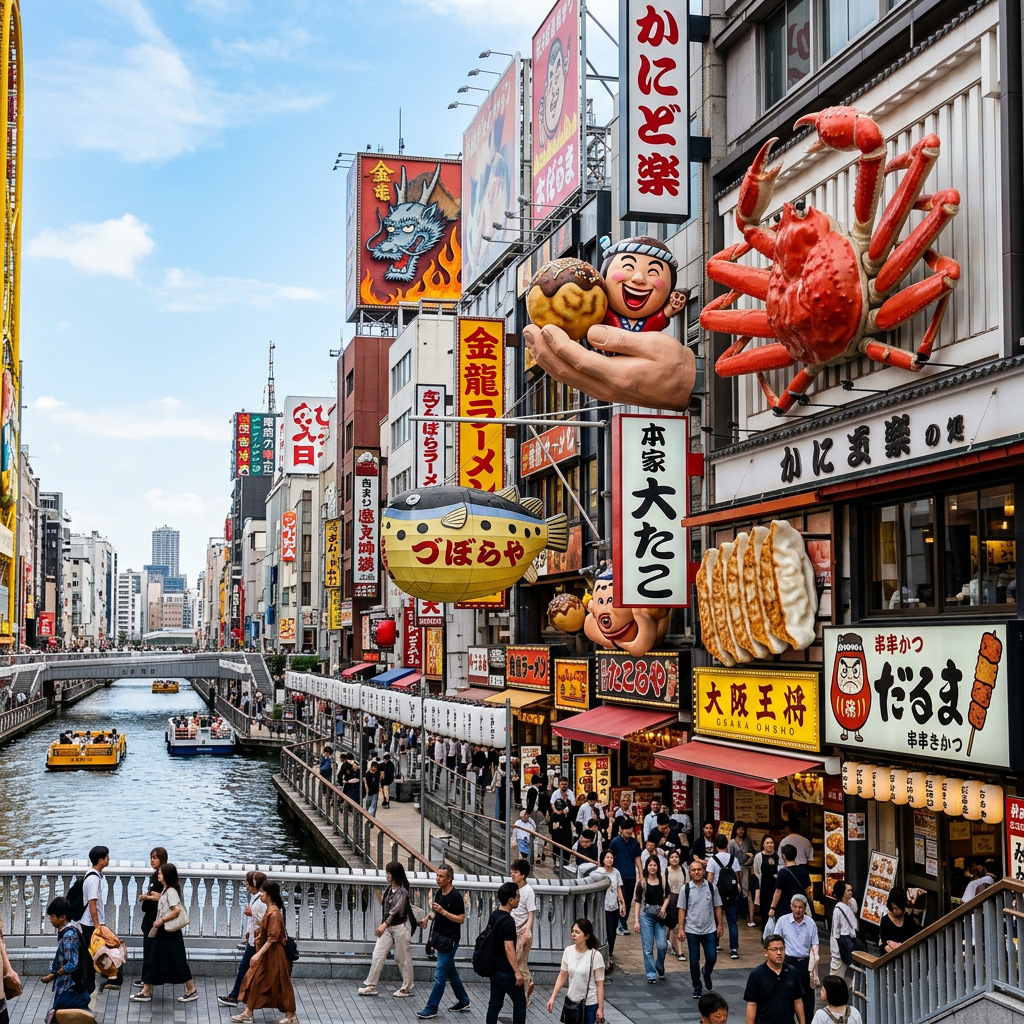
Dotonbori is Osaka concentrated into a single canal-side strip — the towering Glico running man sign, giant mechanical crabs, blazing takoyaki (octopus ball) stalls, ramen counters with queue lines snaking down alleyways, and the smell of grilled skewers drifting across the water. It’s relentless, joyful, and completely unlike anywhere else in Japan. The canal walkway (Dotonboribori) is best experienced at night when the neon reflections turn the water into liquid colour.
The surrounding streets of Namba — Shinsaibashi shopping arcade, Kuromon Ichiba market, the tiny ramen and kushikatsu (deep-fried skewer) restaurants tucked into every alley — reward hours of wandering. This is where Osaka’s legendary food culture is most densely concentrated.
💡 Insider Tip: A guided street food tour of Dotonbori and Namba is one of the best value experiences in Japan — a good guide will take you well beyond the tourist-facing stalls into the backstreets where locals actually eat. Book an evening tour to experience the area at its most spectacular.
🎟 Book a Dotonbori Food Tour via Viator | Klook
🏰 2. Osaka Castle & Castle Park
⏱ Allow: 2–3 hours | 💴 Cost: ¥600 (~$4) castle keep; park free | 🚇 Subway: Tanimachi 4-chome (Tanimachi & Chuo Lines) or Osakajokoen (JR Loop Line) | 📍 1-1 Osakajo, Chuo Ward, Osaka 540-0002
Osaka Castle is one of Japan’s most recognisable landmarks — a magnificent white and green keep rising above a vast park of stone walls, moats, and ancient gates. Originally built by Toyotomi Hideyoshi in 1583, it was the most powerful castle in Japan before being destroyed and rebuilt multiple times. The current reconstruction houses an excellent museum tracing the castle’s history and Hideyoshi’s unification of Japan, with panoramic views from the top floor.
The surrounding Osaka Castle Park is immense and beautiful — one of the best cherry blossom viewing locations in western Japan in late March and early April, with hundreds of trees lining the moats and inner gardens. Even outside blossom season, a walk through the stone-walled inner circuits is deeply atmospheric.
💡 Insider Tip: The castle keep museum is interesting but the real highlight is the castle exterior and the stone walls. Arrive early morning before the tour groups. A bicycle is an excellent way to explore the enormous castle park grounds.
🎟 Book an Osaka Castle Tour via Viator | Klook
🎪 3. Universal Studios Japan (USJ)
⏱ Allow: Full day (8–10 hours) | 💴 Cost: ¥8,600–10,400 (~$58–70) standard; Express Pass from ¥4,800 (~$32) extra | 🚃 Train: JR Yumesaki Line to Universal City Station (direct from Osaka Station, 5 min) | 📍 2-1-33 Sakurajima, Konohana Ward, Osaka 554-0031
Universal Studios Japan is one of the best theme parks in Asia — and home to The Wizarding World of Harry Potter, which many visitors rank as the finest Potter experience anywhere in the world, superior even to the original Universal parks. The attention to detail in Hogsmeade village is extraordinary: Hogwarts castle dominates the skyline, butterbeer flows from carts, and the rides inside the castle are genuinely spectacular.
Beyond Harry Potter, USJ offers Nintendo World (with the Super Nintendo World area being a marvel of game-to-life design), the Jurassic Park ride, Minion Park, and multiple world-class attractions across the park. It gets very busy — an Express Pass for the top attractions is strongly recommended.
💡 Insider Tip: Buy your tickets in advance — USJ frequently sells out on peak days. An Express Pass for Harry Potter and Super Nintendo World is worth every yen. Arrive at opening and head straight for the Potter area before the crowds build.
🎟 Book USJ Tickets via Viator | Klook
🍣 4. Kuromon Ichiba Market
⏱ Allow: 1–2 hours | 💴 Cost: Free entry; budget ¥2,000–5,000 (~$13–34) for food | 🚇 Subway: Nippombashi (Sennichimae & Sakaisuji Lines) | 📍 2-4-1 Nipponbashi, Chuo Ward, Osaka 542-0073
Kuromon Ichiba — “Osaka’s Kitchen” — is a 580-metre covered market that has supplied the city’s restaurants and households with fresh seafood, meat, and produce for nearly 200 years. Unlike tourist markets elsewhere, Kuromon is still very much a working market: whole tuna are butchered at 6am, wagyu beef is sliced to order, and live seafood tanks line the walls. The eat-as-you-go culture here is exceptional — fresh uni (sea urchin) on rice, grilled scallops, wagyu skewers, and giant oysters are all available for a few hundred yen.
The market is most alive in the morning. Come hungry, bring cash, and be prepared to point at things you can’t name but definitely want to try.
💡 Insider Tip: Visit on a weekday morning (before 11am) when it’s busiest with locals rather than tourists. A guided food tour that combines Kuromon with Dotonbori gives the best overview of Osaka’s extraordinary food culture in a single morning.
🎟 Book an Osaka Food Tour via Viator | Klook
🎆 5. Shinsekai & Tsutenkaku Tower
⏱ Allow: 2–3 hours | 💴 Cost: Tsutenkaku Tower ¥900 (~$6); Shinsekai free to walk | 🚇 Subway: Ebisucho (Sakaisuji Line) or Shin-Imamiya (JR Loop Line & Nankai Line) | 📍 Shinsekai, Naniwa Ward, Osaka 556-0002
Shinsekai — “New World” — is one of Osaka’s most distinctive and fascinating neighbourhoods: a retro entertainment district built in 1912 that time largely forgot, now preserved as a wonderfully eccentric pocket of old-school Osaka atmosphere. Tsutenkaku Tower, modelled on the Eiffel Tower, rises above a grid of blowfish lantern-lit streets crammed with kushikatsu (deep-fried skewer) restaurants, pachinko parlours, and shogi-playing retirees.
Kushikatsu is Shinsekai’s defining dish — various ingredients (meat, seafood, vegetables) skewered, breaded, and deep-fried, dipped in a communal sauce (never double-dip — this is the golden rule). The neighbourhood is gritty, authentic, and utterly charming.
💡 Insider Tip: Come for dinner — the neon glow of the kushikatsu restaurants and the Tsutenkaku Tower lit up at night makes Shinsekai one of Osaka’s most atmospheric evening destinations. Remember the sacred rule: never double-dip your skewer in the communal sauce.
🔭 6. Umeda Sky Building & Floating Garden Observatory
⏱ Allow: 1–1.5 hours | 💴 Cost: ¥1,500 (~$10) | 🚃 Train: Osaka/Umeda Station (JR, Midosuji & Hankyu Lines) 10 min walk | 📍 1-1-88 Oyodonaka, Kita Ward, Osaka 531-6039
The Umeda Sky Building is one of Osaka’s most striking pieces of architecture — two towers connected at the top by a circular “floating garden” observatory 170 metres above the city. The open-air rooftop offers 360-degree views across Osaka’s vast urban grid, with Osaka Bay glittering to the west and the hills of Kobe and Kyoto visible on clear days. The escalator ride through the hollow tower centre to reach the top is itself an experience.
The surrounding basement Takimi-koji alley, designed to replicate a 1920s Osaka street, is home to a cluster of excellent restaurants and makes a perfect dinner follow-up to the sunset views from above.
💡 Insider Tip: Visit at sunset for the most dramatic views — the sky turns extraordinary shades of orange and pink over Osaka Bay. The glass escalator connecting the two towers is genuinely thrilling and unlike anything else in Japan.
🦑 7. Takoyaki & Osaka Street Food Crawl
⏱ Allow: 2–3 hours | 💴 Cost: ¥2,000–5,000 (~$13–34) self-guided; guided tours from ¥6,000 (~$40) | 🚇 Subway: Namba (Midosuji Line) is the best base | 📍 Namba & Dotonbori area, Chuo Ward, Osaka
Osaka invented takoyaki — golf ball-sized spheres of batter filled with octopus, tempura scraps, ginger, and green onion, cooked in a special moulded iron pan and served piping hot with bonito flakes dancing in the heat. Every neighbourhood has its own champion takoyaki stall, and the debate over the best in the city is taken extremely seriously. Beyond takoyaki, Osaka’s street food universe includes okonomiyaki (savoury pancakes), negiyaki (green onion pancakes), and kitsune udon.
A guided street food tour is the most efficient and educational way to cover Osaka’s culinary landscape — a good guide covers not just the food but the history and culture that produced it, moving between Dotonbori, Kuromon, and the backstreet izakayas that locals actually frequent.
💡 Insider Tip: Try takoyaki from at least three different stalls — the variation in batter consistency, filling combinations, and sauce application is genuinely fascinating. Wanaka near Shinsaibashi and Aizuya in Namba are two of the most celebrated names in the city.
🎟 Book an Osaka Street Food Tour via Viator | Klook
🛸 8. Tempozan & Osaka Aquarium Kaiyukan
⏱ Allow: 2–3 hours | 💴 Cost: ¥2,700 (~$18) adults; ¥1,400 (~$9) ages 7–15 | 🚇 Subway: Osakako (Chuo Line) 5 min walk | 📍 1-1-10 Kaigandori, Minato Ward, Osaka 552-0022
Kaiyukan is consistently ranked among the top aquariums in the world, and for good reason. The centrepiece is a vast Pacific Ocean tank — the second largest aquarium tank on earth — where whale sharks (the largest fish in the world) glide past alongside manta rays, schools of tuna, and countless other species. The aquarium’s design takes visitors on a journey from the Aleutian Islands through to the Antarctic, with 15 themed zones each representing a different Pacific Rim ecosystem.
Outside, the Tempozan Harbour Village offers waterfront restaurants, a giant Ferris wheel with views across Osaka Bay, and easy access to the Sakishima Cosmo Tower observatory.
💡 Insider Tip: Book tickets online to skip the entrance queue. The whale shark feeding (check the daily schedule at the entrance) is one of the most spectacular sights in any aquarium anywhere in the world. Arrive when it opens for the best experience.
🎟 Book Kaiyukan Aquarium Tickets via Klook
💡 Practical Tips for Osaka
- Get an IC card (Suica or ICOCA): Works on the subway, JR lines, and buses throughout Osaka. Load it at any station machine.
- The Osaka Amazing Pass: Covers unlimited subway travel and free entry to over 40 attractions including Osaka Castle. Excellent value if you’re covering multiple sights in a day or two.
- Eat constantly: Osaka’s food culture is defined by grazing. Small portions, multiple stops, cash in hand. Don’t make the mistake of filling up at one place early in the day.
- Day trip to Kyoto or Nara: Osaka is perfectly positioned as a base for day trips. Kyoto is 15 minutes by Shinkansen; Nara (with its famous wild deer) is 40 minutes by train.
- Escalator etiquette: Stand on the right in Osaka (opposite to Tokyo). This is taken seriously.
This post contains affiliate links. The Wandering Adventurer may earn a small commission if you book through our links, at no extra cost to you. Thank you for supporting independent travel content!
 The Wandering Adventurer
Leave a comment